Showing posts with label structural equation modeling. Show all posts

5/22/2012

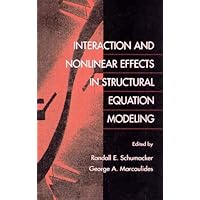
Interaction And Non-Linear Effects In Structural Equation Review

Interaction And Non-Linear Effects In Structural Equation
Average Reviews:

(More customer reviews)
This is an excellent reference book for applied researchers who use advanced structural equation modeling (SEM) in social, psychological, and biomedical studies. The authors are well-known experienced experts in SEM, and the contents of this book are practical. Researcher who use different software in SEM can find their practical examples and related theoretical bases.

Click Here to see more reviews about: Interaction And Non-Linear Effects In Structural Equation

This volume provides a comprehensive presentation of the various procedures currently available for testing interaction and nonlinear effects in structural equation modeling. By focusing on various software applications, the reader should quickly be able to incorporate one of the procedures into testing interaction or nonlinear effects in their own model. Although every attempt is made to keep mathematical details to a minimum, it is assumed that the reader has mastered the equivalent of a graduate-level multivariate statistics course which includes adequate coverage of structural equation modeling. This book will be of interest to researchers and practitioners in education and the social sciences.

Buy Now

Click here for more information about Interaction And Non-Linear Effects In Structural Equation

Read More...

2/12/2012

A First Course in Structural Equation Modeling Review

A First Course in Structural Equation Modeling
Average Reviews:

(More customer reviews)
If you haven't been exposed to SEM , this book is right for you. Basic, straightforward, well planned and nonmathematical. However, this book cannot be the "only" book in your library if you are planning to go deep in SEM. This book is a good step for moving to intermediate or advanced levels.
The book is well desinged. It starts with fundamentals of SEM and EQS and LISREL programs. This book is NOT an EQS or LISREL reference, however, in each chapter, Raykov and Marcoulides cover an example showing the syntax and output of each program. The syntax and the output are deeply explained.
After introducing SEM and EQS and LISREL, the authors start to cover different approaches in SEM. Path analysis, Confirmatory Factor Analysis, Structural Regression Models and finally there is chapter about Latent Change Analysis.
In overall, the book is useful for only beginners as the authors' claim.

Click Here to see more reviews about: A First Course in Structural Equation Modeling

This book is designed to introduce students to the basics of structural equation modeling through a conceptual, nonmathematical approach. The few mathematical formulas included are used in a conceptual or illustrative nature, rather than a computational one. The book features examples from LISREL and EQS. For that reason, the book can also be used as a beginning guide to learning how to set up input files to fit the most commonly used types of structural equation models with these programs. Intended as an introduction for graduate students or researchers in psychology, education, business, and other applied social and health sciences. The only prerequisite is a basic statistics course.

Buy Now

Click here for more information about A First Course in Structural Equation Modeling

Read More...

12/01/2011

Structural Equation Modeling with EQS and EQS/WINDOWS: Basic Concepts, Applications, and Programming Review

Structural Equation Modeling with EQS and EQS/WINDOWS: Basic Concepts, Applications, and Programming
Average Reviews:

(More customer reviews)
Barbara Byrne manages to make a very complicated topic seem manageable and understandable. This book is ideal for people familiar with the basics of psychology statistics, but relatively new at structural equation modeling. My only complaints are that the index is a bit sparse, so I found myself thumbing through the book frequently; and sometimes the details of how to apply the concepts directly to EQS commands were left a bit unclear. However, overall this was an excellent starter book for structural equation newbies!

Click Here to see more reviews about: Structural Equation Modeling with EQS and EQS/WINDOWS: Basic Concepts, Applications, and Programming


Designed to help beginners estimate and test structural equation modeling (SEM) using the EQS approach, this book demonstrates a variety of SEM//EQS applications that include both partial factor analytic and full latent variable models. Beginning with an overview of the basic concepts of SEM and the EQS program, the author works through applications starting with a single sample approach to more advanced applications, such as a multi-sample approach. The book concludes with a section on using EQS for modeling with Windows.


Buy Now

Click here for more information about Structural Equation Modeling with EQS and EQS/WINDOWS: Basic Concepts, Applications, and Programming

Read More...

10/26/2011

Principles and Practice of Structural Equation Modeling Review

Principles and Practice of Structural Equation Modeling
Average Reviews:

(More customer reviews)
Rex Kline easy writing style will take you through step-by-step in one of the most comprehesive yet accessible introductions to multivariate analysis and structural equation modeling. After outlining the building blocks of SEM (multiple regression, path analysis, and factor analysis), Kline gets the reader ready to tackle popular SEM software with examples for AMOS, LISREL and EQS. There is also a great chapter on what NOT to do with this often misused technique. For a preview, see Kline's article in the Journal of Clinical Psychology (1991), Latent variable path analysis: A beginner's tour guide. This book is an excellent read, and a must have for researchers and statisticians.

Click Here to see more reviews about: Principles and Practice of Structural Equation Modeling

Designed for students and researchers without an extensive quantitative background, this book offers an informative guide to the application, interpretation, and pitfalls of structural equation modeling (SEM) in the social sciences. This is an accessible volume which covers introductory techniques, including path analysis and confirmatory factor analysis, and provides an overview of more advanced methods, such as the evaluation of nonlinear effects, the analysis of means in covariance structure models, and latent growth models for longitudinal data. Providing examples from various disciplines to illustrate all aspects of SEM, the author offers clear instructions on the preparation and screening of data, common mistakes to avoid, and features of widely used software programs (Amos, EQS, and LISREL). Readers will acquire the skills necessary to begin to use SEM in their own research and to interpret and critique the use of the method by others.

Buy Now

Click here for more information about Principles and Practice of Structural Equation Modeling

Read More...

9/21/2011

Structural Equation Modeling With AMOS: Basic Concepts, Applications, and Programming (Multivariate Applications Series) Review

Structural Equation Modeling With AMOS: Basic Concepts, Applications, and Programming (Multivariate Applications Series)
Average Reviews:

(More customer reviews)
This book is a wonderful guide to understanding a good range of basics about sem, getting models to work with Amos, and interpreting your output. You will need to be familiar with one of the stats packages that Amos is compatible with. Very much user-friendly in this complicated topic. All of the statistically-related and theory-related aspects are well-referenced, so you can find sources to reference for different aspects of sem. A great book to fill the gap between the Amos user's manual and books on sem in general. (contact Erlbaum about educ pricng.)

Click Here to see more reviews about: Structural Equation Modeling With AMOS: Basic Concepts, Applications, and Programming (Multivariate Applications Series)

This book illustrates the ease with which AMOS 4.0 can be used to address research questions that lend themselves to structural equation modeling (SEM). This goal is achieved by: 1) presenting a nonmathematical introduction to the basic concepts and applications of structural equation modeling; 2) demonstrating basic applications of SEM using AMOS 4.0; and 3) highlighting features of AMOS 4.0 that address important caveats related to SEM analyses.Written in a "user-friendly" style, the author "walks" the reader through 10 SEM applications from model specification to estimation to the assessment and interpretation of the output. Each of the book's applications is accompanied by:a statement of the hypothesis being tested;a schematic representation of the model under study;the use and function of a wide variety of icons and pull-down menus;a full explanation of related AMOS Graphic input models and output files;a model input file based on AMOS BASIC; andthe published reference from which each application was drawn.

Buy Now

Click here for more information about Structural Equation Modeling With AMOS: Basic Concepts, Applications, and Programming (Multivariate Applications Series)

Read More...

9/17/2011

An Introduction to Latent Variable Growth Curve Modeling: Concepts, Issues, and Applications (Quantitative Methodology) (Quantitative Methodology Series) Review

An Introduction to Latent Variable Growth Curve Modeling: Concepts, Issues, and Applications (Quantitative Methodology) (Quantitative Methodology Series)
Average Reviews:

(More customer reviews)
This is an excellent book for anyone who wishes to not only understand the theory behind latent growth curve modeling but also seeing how it is directly applied in a number of situations. For a reader like me who depends upon the literature to help understand newer statistical approaches, a book like this is a breath of fresh air. The book presents very clearly how to set up a basic LGC model and includes other topics such as dealing with missing data, interaction effects and multilevel approaches to longitudinal data analysis. The appendix contains a number of example LGCM models in the software language of EQS, LISREL and AMOS. I most highly recommend this text for beginners and more advanced modelers alike!

Click Here to see more reviews about: An Introduction to Latent Variable Growth Curve Modeling: Concepts, Issues, and Applications (Quantitative Methodology) (Quantitative Methodology Series)

This book provides a comprehensive introduction to latent variable growth curve modeling (LGM) for analyzing repeated measures. It presents the statistical basis for LGM and its various methodological extensions, including a number of practical examples of its use. It is designed to take advantage of the reader's familiarity with analysis of variance and structural equation modeling (SEM) in introducing LGM techniques. Sample data, syntax, input and output, are provided for EQS, Amos, LISREL, and Mplus on the book's CD. Throughout the book, the authors present a variety of LGM techniques that are useful for many different research designs, and numerous figures provide helpful diagrams of the examples.Updated throughout, the second edition features three new chapters-growth modeling with ordered categorical variables, growth mixture modeling, and pooled interrupted time series LGM approaches. Following a new organization, the book now covers the development of the LGM, followed by chapters on multiple-group issues (analyzing growth in multiple populations, accelerated designs, and multi-level longitudinal approaches), and then special topics such as missing data models, LGM power and Monte Carlo estimation, and latent growth interaction models. The model specifications previously included in the appendices are now available on the CD so the reader can more easily adapt the models to their own research.This practical guide is ideal for a wide range of social and behavioral researchers interested in the measurement of change over time, including social, developmental, organizational, educational, consumer, personality and clinical psychologists, sociologists, and quantitative methodologists, as well as for a text on latent variable growth curve modeling or as a supplement for a course on multivariate statistics. A prerequisite of graduate level statistics is recommended.

Buy NowGet 15% OFF

Click here for more information about An Introduction to Latent Variable Growth Curve Modeling: Concepts, Issues, and Applications (Quantitative Methodology) (Quantitative Methodology Series)

Read More...

8/17/2011

A First Course in Structural Equation Modeling Review

A First Course in Structural Equation Modeling
Average Reviews:

(More customer reviews)
This book does a good job of explaining the basic concepts involved in SEM, path analysis, and CFA in easy to understand terms. Also, it lays out syntax and output for running popular SEM programs, such as LISREL, EQS, and Mplus. This book is perfect for the person who is trying to learn SEM on their own. I think it gives you enough to be able to know how to run a SEM, but it isn't enough to really make you a pro at it.

Click Here to see more reviews about: A First Course in Structural Equation Modeling

In this book, authors Tenko Raykov and George A. Marcoulides introduce students to the basics of structural equation modeling (SEM) through a conceptual, nonmathematical approach. For ease of understanding, the few mathematical formulas presented are used in a conceptual or illustrative nature, rather than a computational one.Featuring examples from EQS, LISREL, and Mplus, A First Course in Structural Equation Modeling is an excellent beginner's guide to learning how to set up input files to fit the most commonly used types of structural equation models with these programs. The basic ideas and methods for conducting SEM are independent of any particular software.Highlights of the Second Edition include:' Review of latent change (growth) analysis models at an introductory level' Coverage of the popular Mplus program' Updated examples of LISREL and EQS' A CD that contains all of the text's LISREL, EQS, and Mplus examples.A First Course in Structural Equation Modeling is intended as an introductory book for students and researchers in psychology, education, business, medicine, and other applied social, behavioral, and health sciences with limited or no previous exposure to SEM. A prerequisite of basic statistics through regression analysis is recommended. The book frequently draws parallels between SEM and regression, making this prior knowledge helpful.

Buy NowGet 10% OFF

Click here for more information about A First Course in Structural Equation Modeling

Read More...

8/14/2011

A Step-by-Step Approach to Using the SAS System for Factor Analysis and Structural Equation Modeling Review

A Step-by-Step Approach to Using the SAS System for Factor Analysis and Structural Equation Modeling
Average Reviews:

(More customer reviews)
This book does an outstanding job of taking someone that is somewhat rusty in advanced multivariate techniques and turning them into a conversant and competent modeler. Larry Hatcher uses plain English to explain what a technique may be used for, what the required SAS code is, what the output should look like, and how the output can be interpreted. I'd strongly recommend this book for anyone taking a structural equation modeling course or wishing to apply this technique in research.

Click Here to see more reviews about: A Step-by-Step Approach to Using the SAS System for Factor Analysis and Structural Equation Modeling

Packed with concrete examples, Larry Hatcher's Step-by-Step Approach to Using SAS for Factor Analysis and Structural Equation Modeling provides an introduction to more advanced statistical procedures and includes handy appendixes that give basic instruction in using SAS. Novice SAS users will find all they need in this one volume to master SAS basics and to move into advanced statistical analyses. Featured is a simple, step-by-step approach to testing structural equation models with latent variables using the CALIS procedure. The following topics are explained in easy-to-understand terms: exploratory factor analysis, principal component analysis, and developing measurement models with confirmatory factor analysis. Other topics of note include "LISREL-type" analyses with the user-friendly PROC CALIS and solving problems encountered in real-world social science research.

Buy NowGet 18% OFF

Click here for more information about A Step-by-Step Approach to Using the SAS System for Factor Analysis and Structural Equation Modeling

Read More...