Showing posts with label measurement. Show all posts

4/17/2012

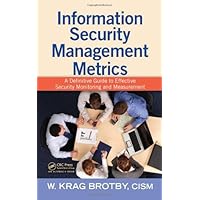
Information Security Management Metrics: A Definitive Guide to Effective Security Monitoring and Measurement Review

Information Security Management Metrics: A Definitive Guide to Effective Security Monitoring and Measurement
Average Reviews:

(More customer reviews)
Measuring information security is the greatest remaining challenge for many of us. Metrics are essential for a scientific management approach, rather than relying purely on gut feel and guesswork. Standards such as ISO/IEC 27001 require the use of objective information about the status and effectiveness of information security controls in relation to the risks, in order to drive appropriate improvements in the Information Security Management System. However, it is not immediately obvious exactly what needs measuring, nor how to do it. This book lays out the foundations on which a rational measurement system can be designed to manage information security in a more objective fashion.
The author encourages readers to consider a wide variety of measurement approaches and apply them sensibly to their information security management issues. In addition to conventional information security metrics, the book draws on governance, risk management, financial management and business analysis methods, a more diverse range of approaches than is normally covered in this field. Introducing measures of organization structure and culture sets this security metrics book apart from most others.
Although the writing style is clear, this is a complex subject covered in depth. Being rather theoretical in approach, the book won't suit practitioners simply looking for a short checklist of `security things to measure'. However, those with the interest and time to study Information Security Management Metrics will be rewarded with a deeper and more rounded understanding of the issue. As such, the book is probably of most value to CISOs and ISMs tasked with implementing better security metrics, and to information security management students.

Click Here to see more reviews about: Information Security Management Metrics: A Definitive Guide to Effective Security Monitoring and Measurement

Spectacular security failures continue to dominate the headlines despite huge increases in security budgets and ever-more draconian regulations. The 20/20 hindsight of audits is no longer an effective solution to security weaknesses, and the necessity for real-time strategic metrics has never been more critical. Information Security Management Metrics: A Definitive Guide to Effective Security Monitoring and Measurement offers a radical new approach for developing and implementing security metrics essential for supporting business activities and managing information risk. This work provides anyone with security and risk management responsibilities insight into these critical security questions: How secure is my organization?How much security is enough?What are the most cost-effective security solutions?How secure is my organization?Solid metrics are the key to cost-effective information security - you can't manage what you can't measure This volume shows readers how to develop metrics that can be used across an organization to assure its information systems are functioning, secure, and supportive of the organization's business objectives. It provides a comprehensive overview of security metrics, discusses the current state of metrics in use today, and looks at promising new developments. Later chapters explore ways to develop effective strategic and management metrics for information security governance, risk management, program implementation and management, and incident management and response. The book ensures that every facet of security required by an organization is linked to business objectives, and provides metrics to measure it. Case studies effectively demonstrate specific ways that metrics can be implemented across an enterprise to maximize business benefit. With three decades of enterprise information security experience, author Krag Brotby presents a workable approach to developing and managing cost-effective enterprise information security.

Buy NowGet 14% OFF

Click here for more information about Information Security Management Metrics: A Definitive Guide to Effective Security Monitoring and Measurement

Read More...

4/12/2012

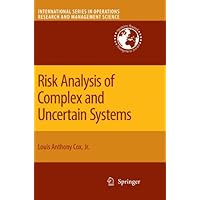
Risk Analysis of Complex and Uncertain Systems (International Series in Operations Research & Management Science) Review

Risk Analysis of Complex and Uncertain Systems (International Series in Operations Research and Management Science)
Average Reviews:

(More customer reviews)
This is an excellent, approachable read for any risk manager; understanding its examples requires only elementary probability, statistics and calculus, though the foundations are much deeper. The author uses direct language, and does not hesitate to declare a fashionable risk analysis technique "worse than useless." The author shows how not to do risk analysis, using simple but devastating examples to illustrate the weaknesses of prioritized investments, subject matter expert opinion, risk matrices and qualitative risk assessments, and the independence assumption. Then, case studies present constructive examples of good practice. Refreshingly, this text clearly distinguishes between threats from Mother Nature, and those posed by an intelligent adversary. There is unevenness, because this is an edited ensemble of papers originally published in a variety of technical journals; however, this is also a strength, because the appeal and scholarship underlying biological, engineering, and social science examples is broad. This is not a how-to guide, and won't help fill in a blank page risk analysis; however, this is an excellent source for the skeptical consumer of contemporary risk management advice and products, and hopefully will have some influence with policy makers who are the source of simplistic and dangerous guidance.

Gerald G. Brown
Distinguished Professor of Operations Research
Naval Postgraduate School
National Academy of Engineering
INFORMS Fellow


Click Here to see more reviews about: Risk Analysis of Complex and Uncertain Systems (International Series in Operations Research & Management Science)

In Risk Analysis of Complex and Uncertain Systems acknowledged risk authority Tony Cox shows all risk practitioners how Quantitative Risk Assessment (QRA) can be used to improve risk management decisions and policies. It develops and illustrates QRA methods for complex and uncertain biological, engineering, and social systems - systems that have behaviors that are just too complex to be modeled accurately in detail with high confidence - and shows how they can be applied to applications including assessing and managing risks from chemical carcinogens, antibiotic resistance, mad cow disease, terrorist attacks, and accidental or deliberate failures in telecommunications network infrastructure. This book was written for a broad range of practitioners, including decision risk analysts, operations researchers and management scientists, quantitative policy analysts, economists, health and safety risk assessors, engineers, and modelers.

Buy Now

Click here for more information about Risk Analysis of Complex and Uncertain Systems (International Series in Operations Research & Management Science)

Read More...

12/01/2011

Structural Equation Modeling with EQS and EQS/WINDOWS: Basic Concepts, Applications, and Programming Review

Structural Equation Modeling with EQS and EQS/WINDOWS: Basic Concepts, Applications, and Programming
Average Reviews:

(More customer reviews)
Barbara Byrne manages to make a very complicated topic seem manageable and understandable. This book is ideal for people familiar with the basics of psychology statistics, but relatively new at structural equation modeling. My only complaints are that the index is a bit sparse, so I found myself thumbing through the book frequently; and sometimes the details of how to apply the concepts directly to EQS commands were left a bit unclear. However, overall this was an excellent starter book for structural equation newbies!

Click Here to see more reviews about: Structural Equation Modeling with EQS and EQS/WINDOWS: Basic Concepts, Applications, and Programming


Designed to help beginners estimate and test structural equation modeling (SEM) using the EQS approach, this book demonstrates a variety of SEM//EQS applications that include both partial factor analytic and full latent variable models. Beginning with an overview of the basic concepts of SEM and the EQS program, the author works through applications starting with a single sample approach to more advanced applications, such as a multi-sample approach. The book concludes with a section on using EQS for modeling with Windows.


Buy Now

Click here for more information about Structural Equation Modeling with EQS and EQS/WINDOWS: Basic Concepts, Applications, and Programming

Read More...

10/05/2011

Constructing Measures: An Item Response Modeling Approach Review

Constructing Measures: An Item Response Modeling Approach
Average Reviews:

(More customer reviews)
The book was required for a class I'm taking, it serves it purpose and got here within a reasonable amount of time.

Click Here to see more reviews about: Constructing Measures: An Item Response Modeling Approach

Constructing Measures introduces a way to understand the advantages and disadvantages of measurement instruments, how to use such instruments, and how to apply these methods to develop new instruments or adapt old ones. The book is organized around the steps taken while constructing an instrument. It opens with a summary of the constructive steps involved. Each step is then expanded on in the next four chapters. These chapters develop the "building blocks" that make up an instrument--the construct map, the design plan for the items, the outcome space, and the statistical measurement model. The next three chapters focus on quality control. They rely heavily on the calibrated construct map and review how to check if scores are operating consistently and how to evaluate the reliability and validity evidence. The book introduces a variety of item formats, including multiple-choice, open-ended, and performance items; projects; portfolios; Likert and Guttman items; behavioral observations; and interview protocols.Each chapter includes an overview of the key concepts, related resources for further investigation and exercises and activities. Some chapters feature appendices that describe parts of the instrument development process in more detail, numerical manipulations used in the text, and/or data results. A variety of examples from the behavioral and social sciences and education including achievement and performance testing; attitude measures; health measures, and general sociological scales, demonstrate the application of the material. An accompanying CD features control files, output, and a data set to allow readers to compute the text's exercises and create new analyses and case archives based on the book's examples so the reader can work through the entire development of an instrument.Constructing Measures is an ideal text or supplement in courses on item, test, or instrument development, measurement, item response theory, or rasch analysis taught in a variety of departments including education and psychology. The book also appeals to those who develop instruments, including industrial/organizational, educational, and school psychologists, health outcomes researchers, program evaluators, and sociological measurers. Knowledge of basic descriptive statistics and elementary regression is recommended.

Buy Now

Click here for more information about Constructing Measures: An Item Response Modeling Approach

Read More...

9/27/2011

Structural Equation Modeling With Eqs: Basic Concepts, Applications, And Programming (Multivariate Applications) (Multivariate Applications Series) Review

Structural Equation Modeling With Eqs: Basic Concepts, Applications, And Programming (Multivariate Applications) (Multivariate Applications Series)
Average Reviews:

(More customer reviews)
Byrne offers a more readable alternative to the hard core approach of learning EQS from its official manual. The latter presents a heavily mathematical framework that might be offputting to some readers who lack a strong statistical background.
Instead, her book goes through much of what EQS can do for you. But at a gentler pace. Giving a brief walkthrough of multivariate statistical modelling. The book starts off explaining the format of the EQS input file. It uses a graphical approach similar to what electrical engineers have for laying out circuits. More intuitive for the user. Where you can draw regressions paths from one component in the diagram to other components, for example. This is reminiscent of how SPICE went from a text input file that described a circuit to a graphical approach that was far easier to understand.
Much of the book then goes into how you can test for causality in your model. EQS has formidable abilities to do so, and you need to master how to control these.

Click Here to see more reviews about: Structural Equation Modeling With Eqs: Basic Concepts, Applications, And Programming (Multivariate Applications) (Multivariate Applications Series)

Researchers and students who want a less mathematical alternative to the EQS manual will find exactly what they're looking for in this practical text. Written specifically for those with little to no knowledge of structural equation modeling (SEM) or EQS, the author's goal is to provide a non-mathematical introduction to the basic concepts of SEM by applying these principles to EQS, Version 6.1. The book clearly demonstrates a wide variety of SEM/EQS applications that include confirmatory factor analytic and full latent variable models. Analyses are based on a wide variety of data representing single and multiple-group models; these include data that are normal/non-normal, complete/incomplete, and continuous/categorical. Written in a "user-friendly" style, the author "walks" the reader through the varied steps involved in the process of testing SEM models. These include model specification and estimation, assessment of model fit, description of EQS output, and interpretation of findings. Each of the book's applications is accompanied by: a statement of the hypothesis being tested, a schematic representation of the model, explanations and interpretations of the related EQS input and output files, tips on how to use the associated pull-down menus and icons, and the data file upon which the application is based. Beginning with an overview of the basic concepts of SEM and the EQS program, the book carefully works through applications starting with relatively simple single group analyses, through to more advanced applications, such as a multi-group, latent growth curve, and multilevel modeling.The new edition features: •many new applications that include a latent growth curve model, a multilevel model, a second-order model based on categorical data, a missing data multigroup model based on the EM algorithm, and the testing for latent mean differences related to a higher-order model; •a CD enclosed with the book that includes all application data; •vignettes illustrating procedural and/or data management tasks using a Windows interface; •description of how to build models both interactively using the BUILDULEQ interface and graphically using the EQS Diagrammer.

Buy Now

Click here for more information about Structural Equation Modeling With Eqs: Basic Concepts, Applications, And Programming (Multivariate Applications) (Multivariate Applications Series)

Read More...