Showing posts with label research. Show all posts

5/01/2012

Handbook of Statistics, Volume 25: Bayesian Thinking, Modeling and Computation Review

Handbook of Statistics, Volume 25: Bayesian Thinking, Modeling and Computation
Average Reviews:

(More customer reviews)
Professor Krishnaiah had the idea of creating a series of handbooks on statstics with each volume covering a major topic or branch of statistical methodology. The handbooks are intended to have research articles that may contain very new developments in the field but also include articles that survey the field to give the professional statistician a great reference to look at when wishing to apply a technique or do new research in the area.
The famous Professor C. R. Rao took over the editing job after Krishnaiah's passing. Professor Rao had previously coedited some of these volumes with Krishnaiah and contributed articles. It was Krishnaiah who brought Rao to the United States and the University of Pittsburgh from India.
This volume covers Bayesian statistics with expository articles on Bayesian principles, statistical models and the computational aspects of the Markov Chain Monte Carlo algorithms that now allow for the solution of many Bayesian problems that were previously not tractable.

Click Here to see more reviews about: Handbook of Statistics, Volume 25: Bayesian Thinking, Modeling and Computation

This volume describes how to develop Bayesian thinking, modelling and computation both from philosophical, methodological and application point of view. It further describes parametric and nonparametric Bayesian methods for modelling and how to use modern computational methods to summarize inferences using simulation. The book covers wide range of topics including objective and subjective Bayesian inferences with a variety of applications in modelling categorical, survival, spatial, spatiotemporal, Epidemiological, software reliability, small area and micro array data. The book concludes with a chapter on how to teach Bayesian thoughts to nonstatisticians.
Key Features:
-Critical thinking on causal effects -Objective Bayesian philosophy -Nonparametric Bayesian methodology -Simulation based computing techniques -Bioinformatics and Biostatistics Key Features:
Critical thinking on causal effects Objective Bayesian philosophy Nonparametric Bayesian methodology Simulation based computing techniques Bioinformatics and Biostatistics

Buy NowGet 9% OFF

Click here for more information about Handbook of Statistics, Volume 25: Bayesian Thinking, Modeling and Computation

Read More...

4/23/2012

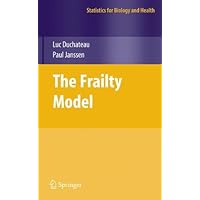
The Frailty Model (Statistics for Biology and Health) Review

The Frailty Model (Statistics for Biology and Health)
Average Reviews:

(More customer reviews)
The authors are academics who have done serious research in survival analysis and are very familiar with frailty models. The topic comes up when time to event data for one event is correlated with the time to event data for another or other events. This topic is sometimes referred to a subject in multivariate survival analysis or the analysis of clustered survival data.
As a professional biostatistician with a keen interest in survival models I have attended professional meetings in recent years and heard the term Frailty Model mentioned but I didn't know what it was. There of course is the natural connotation of weakness as in a feeble or frail person. But the actual formal dtatisticial meaning was a mystery. Other books that I am very familar with deal in part with frailty models but this is to my knowledge the first serious text dedicated to this topic. It also covers related methods to accomplish the same goal such as copulas (another term common in recent books and literature but one I was not familiar with either). For example Philip Hougaard wrote the first advanced text on multivariate survival models and covers parametric forms of frailty models. Klein and Moeschberger wrote a generaal survival analysis book that includes a chapter on semi-parameric fraility models. It showa how the EM algorithm is used to estimate parameters of the models. Ibrahim and colleague wrote a book on Bayesian methods in survival analysis and cover the Bayesian approach to both semi-parametric and parametric fraility models. Therneau and Grambsch wrote a recent book on the Cox proportional hazard model and its extensions. It included information on semi-parametric frailty models using the penalized partial likelihood approach to estimation.
This book is a well-written introduction to fraility models that includes all these methods provides real world examples and good explanations on how to interpret the results. The examples are illustrated using the freeware language R. This book could serve as either an undergraduate or graduate text in statistical methods and is a great reference for biostatisticians.

Click Here to see more reviews about: The Frailty Model (Statistics for Biology and Health)

Readers will find in the pages of this book a treatment of the statistical analysis of clustered survival data. Such data are encountered in many scientific disciplines including human and veterinary medicine, biology, epidemiology, public health and demography. A typical example is the time to death in cancer patients, with patients clustered in hospitals. Frailty models provide a powerful tool to analyze clustered survival data. In this book different methods based on the frailty model are described and it is demonstrated how they can be used to analyze clustered survival data. All programs used for these examples are available on the Springer website.

Buy NowGet 20% OFF

Click here for more information about The Frailty Model (Statistics for Biology and Health)

Read More...

3/18/2012

Data Envelopment Analysis: Modeling Operational Processes And Measuring Productivity Review

Data Envelopment Analysis: Modeling Operational Processes And Measuring Productivity
Average Reviews:

(More customer reviews)
I have several books on DEA. This is the best text book for DEA. The models are well explained and I was able to learn the basic DEA models and their advances by myself. The spreadsheet modeling part is also very useful -- I can build and solve the models. If you are new to DEA, this is definitely the book you want to have.

Click Here to see more reviews about: Data Envelopment Analysis: Modeling Operational Processes And Measuring Productivity

The current book introduces the methodology of data envelopment analysis (DEA). DEA uses mathematical programming techniques and models to evaluate the performance of peer units (e.g., bank branches, hospitals and schools) in terms of multiple inputs used and multiple outputs produced. DEA examines the resources available to each unit and monitors the "conversion" of these resources (inputs) into the desired outputs. The book gives an overview of the various models from the literature, and the geometric interpretations provided permit the reader to go beyond the mathematics. Various topics are covered relating to important practical considerations. These include dealing with time series data as well as methods for restricting multipliers. The book will thus provide students, researchers and practitioners with a solid understanding of the methodology, its uses and its potential.

Buy Now

Click here for more information about Data Envelopment Analysis: Modeling Operational Processes And Measuring Productivity

Read More...

1/06/2012

Ordinal Data Modeling (Statistics for Social and Behavioral Sciences) Review

Ordinal Data Modeling (Statistics for Social and Behavioral Sciences)
Average Reviews:

(More customer reviews)
This book provides both the Bayesian and classical approaches to ordinal data analysis but is unique in emphasizing the Bayesian approach and the latest advances. The authors are academic statisticians and the text is designed for a graduate level course for statistics or social science majors. It includes some very well written introductory material on these two forms fo statistical inference.
The mathematical level is intermediate but is written in a clear way to be accessible to social science students. This is also a good reference book for statisticians especially those involved in educational testing.
Markov chain Monte Carlo methods are provided along with some programmed algorithms for doing Gibbs sampling. A website is available to help the reader get access to datasets and software to implement the procedures.
Although the offer of software is nice, the authors neglect to mention the BUGS software that has been developed in the UK to handle MCMC problems. BUGS or the new window based WinBUGS is easily accessible to the reader and provides a lot of additional modeling aids including diagnostics.
The book covers a lot of interesting and applications oriented topics including logistic regression, ordinal regression, item response models, graded response models and the analysis of ROC curves. Concepts are illustrated and techniques demonstrated through real problems.


Click Here to see more reviews about: Ordinal Data Modeling (Statistics for Social and Behavioral Sciences)

Ordinal Data Modeling is a comprehensive treatment of ordinal data models from both likelihood and Bayesian perspectives. A unique feature of this text is its emphasis on applications. All models developed in the book are motivated by real datasets, and considerable attention is devoted to the description of diagnostic plots and residual analyses. Software and datasets used for all analyses described in the text are available on websites listed in the preface.

Buy NowGet 20% OFF

Click here for more information about Ordinal Data Modeling (Statistics for Social and Behavioral Sciences)

Read More...

12/12/2011

Using LISREL for Structural Equation Modeling: A Researcher's Guide Review

Using LISREL for Structural Equation Modeling: A Researcher's Guide
Average Reviews:

(More customer reviews)
In teaching structural equation modeling in a doctoral-level graduate class, I found Kelloway's book one of the most useful resources. Despite its title, the book is not only about LISREL. The initial chapters provide an excellent overview of the science (and art) of structural equation modeling. Kelloway provides probably a better summary than most other books on the topic.

Click Here to see more reviews about: Using LISREL for Structural Equation Modeling: A Researcher's Guide


This highly readable introduction to structural equation modeling is designed for researchers and graduate students in the social sciences who want to use structural equation modeling techniques to answer substantive research questions. An overview of structural equation modeling includes the theory and logic of structural equation models, assessing the "fit" of structural equation models to the data, and their SEMs implementation in the LISREL environment.


Buy NowGet 15% OFF

Click here for more information about Using LISREL for Structural Equation Modeling: A Researcher's Guide

Read More...

12/03/2011

DNA Microarrays and Gene Expression: From Experiments to Data Analysis and Modeling Review

DNA Microarrays and Gene Expression: From Experiments to Data Analysis and Modeling
Average Reviews:

(More customer reviews)
This book tries to combine a practical and theoretical point of view concering microarray expermiments and the data analyis thereof. This is a very honourable goal. Unfortunatelly, it fails. An indicator for this can already be seen in the low number of pages. This book has less than 140 pages (I exclude the last chapter and the appendix). It is clear, that it is impossible to discuss in detail this topic in this limited number of pages. Hence, during reading the chapters one gets the feeling, that one reads short essays which are stringed together. At no point the authors go into detail but give only a short idea and references.
I see no reason, why I should recommend this book to anyone. It is in its current form just immature. My prediction: There will be no second edition because even its basic substance is very weak.
Some words to the last chapter (systems biology). This is indeed the most interesting and best chapter of the book (35 pages) without going into details as the rest of the book. I think according to this chapter one realize under which premise this book was written. Unfortunatelly, combining buzz worlds in short essays is not enough for a good book. Sorry guys, I think you can do better!

Click Here to see more reviews about: DNA Microarrays and Gene Expression: From Experiments to Data Analysis and Modeling

Massive data acquisition technologies--such as genome sequencing, high-throughput drug screening, and DNA arrays--are in the process of revolutionizing biology and medicine. This concise, user-friendly and interdisciplinary guide to DNA microarray technology is an introduction and a reference for both biologists and computational scientists. The authors describe the underlying technologies and offer an awareness of the "noise" and pitfalls present in the data generated. They also provide an idea of the different data mining techniques and algorithms that are available to interpret data, and the advantages and disadvantages of each in differing situations.

Buy Now

Click here for more information about DNA Microarrays and Gene Expression: From Experiments to Data Analysis and Modeling

Read More...

9/21/2011

Structural Equation Modeling With AMOS: Basic Concepts, Applications, and Programming (Multivariate Applications Series) Review

Structural Equation Modeling With AMOS: Basic Concepts, Applications, and Programming (Multivariate Applications Series)
Average Reviews:

(More customer reviews)
This book is a wonderful guide to understanding a good range of basics about sem, getting models to work with Amos, and interpreting your output. You will need to be familiar with one of the stats packages that Amos is compatible with. Very much user-friendly in this complicated topic. All of the statistically-related and theory-related aspects are well-referenced, so you can find sources to reference for different aspects of sem. A great book to fill the gap between the Amos user's manual and books on sem in general. (contact Erlbaum about educ pricng.)

Click Here to see more reviews about: Structural Equation Modeling With AMOS: Basic Concepts, Applications, and Programming (Multivariate Applications Series)

This book illustrates the ease with which AMOS 4.0 can be used to address research questions that lend themselves to structural equation modeling (SEM). This goal is achieved by: 1) presenting a nonmathematical introduction to the basic concepts and applications of structural equation modeling; 2) demonstrating basic applications of SEM using AMOS 4.0; and 3) highlighting features of AMOS 4.0 that address important caveats related to SEM analyses.Written in a "user-friendly" style, the author "walks" the reader through 10 SEM applications from model specification to estimation to the assessment and interpretation of the output. Each of the book's applications is accompanied by:a statement of the hypothesis being tested;a schematic representation of the model under study;the use and function of a wide variety of icons and pull-down menus;a full explanation of related AMOS Graphic input models and output files;a model input file based on AMOS BASIC; andthe published reference from which each application was drawn.

Buy Now

Click here for more information about Structural Equation Modeling With AMOS: Basic Concepts, Applications, and Programming (Multivariate Applications Series)

Read More...

8/13/2011

Modeling with Technology: Mindtools for Conceptual Change (3rd Edition) Review

Modeling with Technology: Mindtools for Conceptual Change (3rd Edition)
Average Reviews:

(More customer reviews)
I'm an instructional designer and I've chosen to use this book as both for a text in classes I instruct and as a handbook for working with faculty members at my university. The book focuses on ways to help students think better using technology tools, many of which are commonly available (such as spreadsheets). Many such books focus on ways to use technology first, with practical applications for teaching and learning second. Not so in this case. If you have to buy just one book on instructional technology, this is the one.

Click Here to see more reviews about: Modeling with Technology: Mindtools for Conceptual Change (3rd Edition)

Well-known foraddressing the use of computers to foster critical-thinking and problem solving, this text was written to teach current and future teachers how to better engage learners more mindfully and meaningfully in the process oflearning.Available now in it's Third Edition, it focuses on how to use technology to support meaningful learning through model building, providing powerful strategies for engaging, supporting, and assessing coonceptual change in learners.

Buy NowGet 15% OFF

Click here for more information about Modeling with Technology: Mindtools for Conceptual Change (3rd Edition)

Read More...