Showing posts with label finance. Show all posts

7/07/2012

Utility-Based Learning from Data (Chapman & Hall/CRC Machine Learning & Pattern Recognition) Review

Utility-Based Learning from Data (Chapman and Hall/CRC Machine Learning and Pattern Recognition)
Average Reviews:

(More customer reviews)
This book is just as great inside the cover as
the elegant cover leads you to expect.
A very ambitious book with a very broad scope.
As a Professor of Applied Mathematics and
of mathematical finance, I very much look
forward to presenting parts of this material
in the future.
Concerning the contents, citing from the introduction of
the book:"Our point of view is motivated by the notion that probabilistic models are
usually not learned for their own sake-rather, they are used to make decisions"
and "finance and decision theory provide a language in which it is
natural to express these assumptions-namely, utility theory-and formulate,
from first principals, model performance measures and the notion of optimal
and robust model performance"
and the books purpose is : " to provide a pedagogical and self-contained discussion of a select set of
methods for estimating probability distributions that can be approached
coherently from a decision-theoretic point of view"
The last sentence is extremely telling. Friedman and Sandow indeed
demonstrate in this book that, in struggling to quantify
default risk, in their daytime jobs at Standard and Poor's,
they carefully put into place their own approach, and painstakingly
tested it on read data, throughout many different economic
cycles (as far back as 2001, when I worked in Friedman's group).
In addition, after Friedman presented some of this material at
New York University's Courant Institute, Friedman and Sandow saw fit to
include a through introduction to topics which are of interest
to all economic students, such as utility theory and
minimum relative theory. And they do so in a crisp, clear and no-nonsense
manner that is rarely seen in books on economics.
A key aspect of the point of view taken in this book, is to relate
betting odds, such as in a horse race, to expected
growth of wealth.
Readers should race to the bookstore to get a
hold of this book!

Click Here to see more reviews about: Utility-Based Learning from Data (Chapman & Hall/CRC Machine Learning & Pattern Recognition)

Utility-Based Learning from Data provides a pedagogical, self-contained discussion of probability estimation methods via a coherent approach from the viewpoint of a decision maker who acts in an uncertain environment. This approach is motivated by the idea that probabilistic models are usually not learned for their own sake; rather, they are used to make decisions. Specifically, the authors adopt the point of view of a decision maker who(i) operates in an uncertain environment where the consequences of possible outcomes are explicitly monetized,(ii) bases his decisions on a probabilistic model, and(iii) builds and assesses his models accordingly.These assumptions are naturally expressed in the language of utility theory, which is well known from finance and decision theory. By taking this point of view, the book sheds light on and generalizes some popular statistical learning approaches, connecting ideas from information theory, statistics, and finance. It strikes a balance between rigor and intuition, conveying the main ideas to as wide an audience as possible.

Buy NowGet 19% OFF

Click here for more information about Utility-Based Learning from Data (Chapman & Hall/CRC Machine Learning & Pattern Recognition)

Read More...

6/10/2012

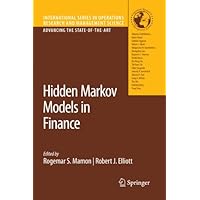
Hidden Markov Models in Finance (International Series in Operations Research & Management Science) Review

Hidden Markov Models in Finance (International Series in Operations Research and Management Science)
Average Reviews:

(More customer reviews)
Hidden Markov Models have come into vogue in recent years in various fields. Notably automatic speech recognition. An HMM is useful in a Bayesian context, where you have to work back from some observations to discern an underlying probability model that is supposedly generating those observations. Often in the presence of noise. Well, it turns out that this general description can also be applied to financial models, which is the book's subject.
Various specific models are tackled. Including the seminal Black-Scholes, where the security market is modelled as a Markov modulated Brownian. Typically, the maths in the book uses sophisticated probabilistic analysis and often assuming Markov processes. As an aside, if your field is electrical engineering or information theory, where you might have used Markov processes, then your background should suffice if you want to migrate to finance. It's not that different, at a certain conceptual level.
The book could be improved by the addition of an index.

Click Here to see more reviews about: Hidden Markov Models in Finance (International Series in Operations Research & Management Science)

A number of methodologies have been employed to provide decision making solutions globalized markets. Hidden Markov Models in Finance offers the first systematic application of these methods to specialized financial problems: option pricing, credit risk modeling, volatility estimation and more. The book provides tools for sorting through turbulence, volatility, emotion, chaotic events - the random "noise" of financial markets - to analyze core components.

Buy NowGet 20% OFF

Click here for more information about Hidden Markov Models in Finance (International Series in Operations Research & Management Science)

Read More...

6/04/2012

Applied Probability and Stochastic Processes Review

Applied Probability and Stochastic Processes
Average Reviews:

(More customer reviews)
I randomly ran across this book in my math library trying to find an extra book to help with the difficult Stochastics Process class I was taking. Little did I know I would find a book I value as much as Douglas Kelly's Introduction to Probability. This book has applied problems and examples! It is not the dry, endless pages of confusing equations we have come to expect from Stochastics Processes books. There is something better out there! This book saved me as an undergraduate, and am now looking forward to it living up to my God like expecations as a post grad. If you are a professor, please use this book for you students. It ties together and lets you appreciate many fields such as linear analysis and even graph theory from computer science. This book will not disappoint.

Click Here to see more reviews about: Applied Probability and Stochastic Processes

This book presents applied probability and stochastic processes in an elementary but mathematically precise manner, with numerous examples and exercises to illustrate the range of engineering and science applications of the concepts. The book is designed to give the reader an intuitive understanding of probabilistic reasoning, in addition to an understanding of mathematical concepts and principles. The initial chapters present a summary of probability and statistics and then Poisson processes, Markov chains, Markov processes and queuing processes are introduced. Advanced topics include simulation, inventory theory, replacement theory, Markov decision theory, and the use of matrix geometric procedures in the analysis of queues.Included in the second edition are appendices at the end of several chapters giving suggestions for the use of Excel in solving the problems of the chapter. Also new in this edition are an introductory chapter on statistics and a chapter on Poisson processes that includes some techniques used in risk assessment. The old chapter on queues has been expanded and broken into two new chapters: one for simple queuing processes and one for queuing networks. Support is provided through the web site http://apsp.tamu.edu where students will have the answers to odd numbered problems and instructors will have access to full solutions and Excel files for homework.

Buy NowGet 21% OFF

Click here for more information about Applied Probability and Stochastic Processes

Read More...

4/21/2012

Applied Econometrics Using the SAS System Review

Applied Econometrics Using the SAS System
Average Reviews:

(More customer reviews)
This book provides an introduction to a variety of analytical methods and how to implement them using SAS. Each topic covered starts with a concise overview of the theory, and demonstrates how to implement the method using matrix algebra with SAS IML, then discusses examples using the relevant SAS procedures. Many of the examples are drawn from standard textbooks used for university econometrics courses. Very few colleges seem to use SAS as the programming environment for econometrics or statistics courses even though SAS is pervasive in the business world where most students will spend their working careers. This book will be useful for both students and practitioners.

Click Here to see more reviews about: Applied Econometrics Using the SAS System

The first cutting-edge guide to using the SAS® system for the analysis of econometric data
Applied Econometrics Using the SAS® System is the first book of its kind to treat the analysis of basic econometric data using SAS®, one of the most commonly used software tools among today's statisticians in business and industry. This book thoroughly examines econometric methods and discusses how data collected in economic studies can easily be analyzed using the SAS® system.
In addition to addressing the computational aspects of econometric data analysis, the author provides a statistical foundation by introducing the underlying theory behind each method before delving into the related SAS® routines. The book begins with a basic introduction to econometrics and the relationship between classical regression analysis models and econometric models. Subsequent chapters balance essential concepts with SAS® tools and cover key topics such as:

Regression analysis using Proc IML and Proc Reg

Hypothesis testing

Instrumental variables analysis, with a discussion of measurement errors, the assumptions incorporated into the analysis, and specification tests

Heteroscedasticity, including GLS and FGLS estimation, group-wise heteroscedasticity, and GARCH models

Panel data analysis

Discrete choice models, along with coverage of binary choice models and Poisson regression

Duration analysis models

Assuming only a working knowledge of SAS®, this book is a one-stop reference for using the software to analyze econometric data. Additional features include complete SAS® code, Proc IML routines plus a tutorial on Proc IML, and an appendix with additional programs and data sets. Applied Econometrics Using the SAS® System serves as a relevant and valuable reference for practitioners in the fields of business, economics, and finance. In addition, most students of econometrics are taught using GAUSS and STATA, yet SAS® is the standard in the working world; therefore, this book is an ideal supplement for upper-undergraduate and graduate courses in statistics, economics, and other social sciences since it prepares readers for real-world careers.

Buy NowGet 22% OFF

Click here for more information about Applied Econometrics Using the SAS System

Read More...

2/10/2012

Spreadsheet Modeling in Corporate Finance Review

Spreadsheet Modeling in Corporate Finance
Average Reviews:

(More customer reviews)
Although intended as a supplement for textbooks used in college level business courses, this book is also valuable to working professionals who deal with financial modeling. Because I am a consultant and project manager I'm going to slant this review towards how my peers will benefit from the book. It's value outside of my narrow scope should be apparent.
First, unlike other books that teach spreadsheet modeling, the spreadsheets that come on the CD ROM are not finished products. Instead the author has chosen spreadsheets that use dynamic charts to illustrate concepts in an interactive manner (drag a control to change the parameters and the chart changes - this is a powerful teaching tool in or out of the classroom).
Second, the book needs to be read in sequence because spreadsheets you build in one chapter are the basis for refinements and added complexity in later chapters. This leads to highly complex spreadsheets, such as the model in chapter 16 (Life-Cycle Financial Planning), which incorporates tax parameters (federal and state levels), benefits analysis and other factors.
In all there are 53 spreadsheets presented in this book, and you build them. The author calls this "active learning" (as opposed to passive learning where you are provided templates), and it is effective because you are the one who builds the models and tools while following the book. Note that this book does NOT purport to teach Excel programming, but how to build models using Excel's basic features and functions.
As a consultant and project manager the parts of this book that were immediately useful to me were: Parts I (Time Value of Money), III (Capital Budgeting) and IV (Financial Planning). In particular, project management requires a thorough understanding of time value of money and capital budgeting, and the chapters in these sections should be read by anyone who is assigned as a project manager. Financial planning, especially from the perspective of IT asset management, is another knowledge area in which IT consultants should be well versed.
The other parts of the book (II Valuation and V Options and Corporate Finance) will be more useful to finance professionals and general business managers. There is a collection of supporting material on the author's web site that augment this book, including spreadsheets that can be downloaded. Another plus for the working professional is the book is fast-paced and, dare I say, engrossing.

Click Here to see more reviews about: Spreadsheet Modeling in Corporate Finance

If you build it, you will learn.*Comes as a book and CD-ROM that teaches students how to build financial models in Excel *Provides instructions for building financial models, not templates *Progresses from simple examples to complex real-world applications *Is available is alternative versions that match the notation of most Prentice Hall Corporate Finance textbooks and other popular textbooks *Includes end-of-chapter problems *Has been extensively classroom-tested

Buy Now

Click here for more information about Spreadsheet Modeling in Corporate Finance

Read More...

2/05/2012

Modeling Financial Markets : Using Visual Basic.NET and Databases to Create Pricing, Trading, and Risk Management Models Review

Modeling Financial Markets : Using Visual Basic.NET and Databases to Create Pricing, Trading, and Risk Management Models
Average Reviews:

(More customer reviews)
This is a "How To Program" book which uses financial applications as samples. It is heavy on programming basics and scratches the surface of financial modeling. That's fine if that's what you expect from the book, but the title led me to believe that I'd learn modeling techniques. I expected a book that assumed proficiency in VB and dealt with moderate to advanced financial topics.
If you already know what a where clause is and are proficient at VB.Net, this is not for you. If you know nothing about VB and want to learn it using interesting examples, this is for you.


Click Here to see more reviews about: Modeling Financial Markets : Using Visual Basic.NET and Databases to Create Pricing, Trading, and Risk Management Models


Limitations in today's software packages for financial modeling system development can threaten the viability of any system--not to mention the firm using that system. Modeling Financial Markets is the first book to take financial professionals beyond those limitations to introduce safer, more sophisticated modeling methods. It contains dozens of techniques for financial modeling in code that minimize or avoid current software deficiencies, and addresses the crucial crossover stage in which prototypes are converted to fully coded models.


Buy Now

Click here for more information about Modeling Financial Markets : Using Visual Basic.NET and Databases to Create Pricing, Trading, and Risk Management Models

Read More...

12/18/2011

Modeling And Forecasting Primary Commodity Prices Review

Modeling And Forecasting Primary Commodity Prices
Average Reviews:

(More customer reviews)
Quantitative analysis applied to trading futures markets. This is the basis of the modern school of trading. Not for the innumeric, however.

Click Here to see more reviews about: Modeling And Forecasting Primary Commodity Prices

The publication of this book at this time is particularly important. Recent economic growth in China and other Asian countries has led to increased commodity demand which has caused price rises and accompanying price fluctuations not only for crude oil but also for the many other raw materials. Such trends mean that world commodity markets are once again under intense scrutiny. This book provides new insights into the modeling and forecasting of primary commodity prices by featuring comprehensive applications of the most recent methods of statistical time series analysis. The latter utilise econometric methods concerned with structural breaks, unobserved components, chaotic discovery, long memory, heteroskedasticity, wavelet estimation and fractional integration. Relevant tests employed include neural networks, correlation dimensions, Lyapunov exponents, fractional integration and rescaled range. The price forecasting involves recent modeling approaches including STS, ARIMA, ARFIMA, and ARCH and GARCH models. Practical applications focus on the price behavior of more than twenty international commodity markets.

Buy Now

Click here for more information about Modeling And Forecasting Primary Commodity Prices

Read More...

Heavy-Tail Phenomena: Probabilistic and Statistical Modeling (Springer Series in Operations Research and Financial Engineering) Review

Heavy-Tail Phenomena: Probabilistic and Statistical Modeling (Springer Series in Operations Research and Financial Engineering)
Average Reviews:

(More customer reviews)
Sid Resnick taught me stochastic processes when I was a graduate student at Stanford. He is an exceptional lecturer who really stimulates the students. I don't think I ever had a boring lecture from him even though probability theory and stochastic processes can at times be very dry subjects.
Over the many years since then Sid has moved on and spent many fruitful years at Colorado State and now Cornell. In addition to his many excellent papers and his fine collaborative work with Richard Davis, he has written a large number of very interesting and thought provoking texts on extreme value theory, stochastic processes and probability theory. I have a deep appreciation for his contributions to the theory of extremes as that has also been one of my research areas and was the topic of my Ph.D. dissertation. This is the second outstanding book Resnick has written on extremes. This one has more of a modelling flavor to it with an eye toward financial applications. It seems these days that much of the research in time series modelling and stochastic processes is motivated by applications in finance. This is certainly also the case with extreme value models as can be seen by the many fine books on extremes that have appeared recently.
This book shows the theory and applications of models for heavy-tailed distributions. Resnick makes a very good point about insurance claim cost. This was certainly a phenomena I had to deal with when modeling workers compensation insurance claims at Risk Data Corporation. It is also interesting to see coverage about what is needed to consistently estimate extreme values by bootstrapping.
Time series models that deal with heavy-tailed distributions are also mentioned.

Click Here to see more reviews about: Heavy-Tail Phenomena: Probabilistic and Statistical Modeling (Springer Series in Operations Research and Financial Engineering)

This comprehensive text gives an interesting and useful blend of the mathematical, probabilistic and statistical tools used in heavy-tail analysis. It is uniquely devoted to heavy-tails and emphasizes both probability modeling and statistical methods for fitting models.Prerequisites for the reader include a prior course in stochastic processes and probability, some statistical background, some familiarity with time series analysis, and ability to use a statistics package. This work will serve second-year graduate students and researchers in the areas of applied mathematics, statistics, operations research, electrical engineering, and economics.

Buy NowGet 19% OFF

Click here for more information about Heavy-Tail Phenomena: Probabilistic and Statistical Modeling (Springer Series in Operations Research and Financial Engineering)

Read More...

12/14/2011

Modeling Risk: Applying Monte Carlo Simulation, Real Options Analysis, Forecasting, and Optimization Techniques (Wiley Finance) Review

Modeling Risk: Applying Monte Carlo Simulation, Real Options Analysis, Forecasting, and Optimization Techniques (Wiley Finance)
Average Reviews:

(More customer reviews)
I found the discussion on nonparametric simulation, though brief, to be very helpful. The book also inspired me to use Excel's Solver in ways I had not considered before.
Beyond that, I was disappointed. The book is poorly edited and lacks a coherent structure. Once in a while, entire strings of paragraphs are repeated in two different parts of the book. More serious, however, is the fact that the book is largely an advertisement for the author's proprietary software.
If you are looking for a few techniques that you can apply in an Excel environment, you will find a few nuggets here and there. However, you will mostly be skimming through the 600 pages of rambling discussion.

Click Here to see more reviews about: Modeling Risk: Applying Monte Carlo Simulation, Real Options Analysis, Forecasting, and Optimization Techniques (Wiley Finance)

This completely revised and updated edition of Applied Risk Analysis includes new case studies in modeling risk and uncertainty as well as a new risk analysis CD-ROM prepared by Dr. Mun. On the CD-ROM you'll find his Risk Simulator and Real Options Super Lattice Solver software as well as many useful spreadsheet models.
"Johnathan Mun's book is a sparkling jewel in my finance library. Mun demonstrates a deep understanding of the underlying mathematical theory in his ability to reduce complex concepts to lucid explanations and applications. For this reason, he's my favorite writer in this field."—Janet Tavakoli, President, Tavakoli Structured Finance, Inc. and author of Collateralized Debt Obligations and Structured Finance
"A must-read for product portfolio managers . . . it captures the risk exposure of strategic investments, and provides management with estimates of potential outcomes and options for risk mitigation."—Rafael E. Gutierrez, Executive Director of Strategic Marketing and Planning, Seagate Technology, Inc.
"Once again, Dr. Mun has created a 'must-have, must-read' book for anyone interested in the practical application of risk analysis. Other books speak in academic generalities, or focus on one area of risk application. [This book] gets to the heart of the matter with applications for every area of risk analysis. You have a real option to buy almost any book?you should exercise your option and get this one!"—Glenn Kautt, MBA, CFP, EA, President and Chairman, The Monitor Group, Inc.
Note: CD-ROM/DVD and other supplementary materials are not included as part of eBook file.

Buy Now

Click here for more information about Modeling Risk: Applying Monte Carlo Simulation, Real Options Analysis, Forecasting, and Optimization Techniques (Wiley Finance)

Read More...

12/07/2011

Structural Equation Modeling with LISREL: Essentials and Advances Review

Structural Equation Modeling with LISREL: Essentials and Advances
Average Reviews:

(More customer reviews)
The book is best at presenting the theory and has excellent discussions of advanced estimation issues. The book, however, is not as useful in conveying the nuts and bolts of how to use LISREL.

Click Here to see more reviews about: Structural Equation Modeling with LISREL: Essentials and Advances

Hayduk is equally at ease explaining the simplest and most advanced applications of the program . . . Hayduk has written more than just a solid text for use in advanced graduate courses on statistical modeling. Those with a firm mathematical background who wish to learn about the approach, or those who know a little about the program and want to know more, will find this an excellent reference.

Buy Now

Click here for more information about Structural Equation Modeling with LISREL: Essentials and Advances

Read More...

11/21/2011

Financial Modeling Under Non-Gaussian Distributions (Springer Finance) Review

Financial Modeling Under Non-Gaussian Distributions (Springer Finance)
Average Reviews:

(More customer reviews)
This book is an outstanding a clear presentation of non-Gaussian financial modeling. In financial markets, the Gaussian curve or bell curve, is not accurate in that most markets are skewed (a predisposition to grow on average, not zero) and fat-tailed (rare events such as market crashes happen more often than a Gaussian curve would suggest). Therefore, non-Gaussian modeling is essential to make money in the market or assess risk. This book goes through all the new techniques of non-Gaussian modeling. It does an exceptional job discussing the GARCH generalized autoregressive conditional heteroskedasticity. This is but a fancy word for fluctuations in volatility over time pretty much dependent on recent fluctuations. It works very well I must say empirically, and has tripled the rationality and profitability of my portfolio - especially one of the versions of the GARCH over the others reviewed - but which one I'd rather not say, for obvious reasons ;) The book is weakest at page 183 or so, with the models and I was rather disappointed with the exclusion of the market crash of the 80s in the empirical analysis - wouldn't rare events be the main reason for improving non-Gaussian modeling? Anyway it's rather poor, but thorough, with additive and multivariate GARCHes but the fault lies with the faultiness of the theories not the authors, at least they're encyclopedic. The book picks up at the end with copulas, and a complete discussion of non-Gaussian option pricing. The review of BSM is appreciated and actually well-done, and a nice reminder of what we are trying to improve on exactly. I think this is a most incredible book, very clearly written, and at times, quite an enjoyable read for such a topic. All it takes is multivariate calculus and basic statistics, but more math ability will make the implications and comments breathtaking at times. I often find myself inspired by a passage or footnote to create a whole subroutine in R or python. I think avoiding Bayesian topics and Monte Carlo was disappointing, but wise in terms of focus. A great book for graduate mathematics in applications of statistics or stochastic calculus, or a good book for modeling fundamentals in economics or business management at the post-graduate level.


Click Here to see more reviews about: Financial Modeling Under Non-Gaussian Distributions (Springer Finance)

This book examines non-Gaussian distributions. It addresses the causes and consequences of non-normality and time dependency in both asset returns and option prices. The book is written for non-mathematicians who want to model financial market prices so the emphasis throughout is on practice. There are abundant empirical illustrations of the models and techniques described, many of which could be equally applied to other financial time series.

Buy NowGet 20% OFF

Click here for more information about Financial Modeling Under Non-Gaussian Distributions (Springer Finance)

Read More...

11/07/2011

Stochastic Modeling of Electricity and Related Markets (Advanced Series on Statistical Science and Applied Probability) Review

Stochastic Modeling of Electricity and Related Markets (Advanced Series on Statistical Science and Applied Probability)
Average Reviews:

(More customer reviews)
I am currently working as a quant in one of the larger energy companies.
All in all, I find the book among the most versatile and to the point in day to day challenges for quants in the energy market. It has a really good balance and connection between theory, real life markets and challenges and empirical findings. You should be fairly accustomed to Stochastic calculus (e.g. Ito-calc) to benefit from the technical chapters in the book.
The book is very systematic and pedagogic in its form combined with a very theoretic core. Opposed to many similar books, the text around the mathematics is guiding you in your decisions and literally full of references which will help you further in solving problems in the real world. An especially good thing about the text is all small hints on how you should set up the model to stay out of trouble on a later stage in the modeling. May save you a lot of work and irritations on a later stage.
The book looks at two different model approaches (geometric and arithmetic), and gives good information about each approach throughout the text, such as limitations, advantages and parameter estimation. It also uses three markets as example markets: power, gas and temperature. All markets are modeled and discussed extensively, and at this level of mathematical modeling I believe this is the most concise treatment of weather derivatives publicly available. It has a chapter alone dedicated to modeling of weather derivatives, with empirical results.
The book explains forward curve generation and smoothing principles in details, and also gives estimated parameters for a real life example. It has own sections for the market price of risk, both from the practical and theoretical side, and also shows how to model spikes and the authors success with different approaches catching the heavy tales and spikes.
The book takes you through options and hedging such that it is easy applicable to many of the deal structures containing flex or optionality. It includes theory and empirical results for standard options with jumps, but also spread and Asian options, and a direct approach for spark spread options.


Click Here to see more reviews about: Stochastic Modeling of Electricity and Related Markets (Advanced Series on Statistical Science and Applied Probability)

The markets for electricity, gas and temperature have distinctive features, which provide the focus for countless studies. For instance, electricity and gas prices may soar several magnitudes above their normal levels within a short time due to imbalances in supply and demand, yielding what is known as spikes in the spot prices. The markets are also largely influenced by seasons, since power demand for heating and cooling varies over the year. The incompleteness of the markets, due to nonstorability of electricity and temperature as well as limited storage capacity of gas, makes spot-forward hedging impossible. Moreover, futures contracts are typically settled over a time period rather than at a fixed date. All these aspects of the markets create new challenges when analyzing price dynamics of spot, futures and other derivatives.
This book provides a concise and rigorous treatment on the stochastic modeling of energy markets. Ornstein Uhlenbeck processes are described as the basic modeling tool for spot price dynamics, where innovations are driven by time-inhomogeneous jump processes. Temperature futures are studied based on a continuous higher-order autoregressive model for the temperature dynamics. The theory presented here pays special attention to the seasonality of volatility and the Samuelson effect. Empirical studies using data from electricity, temperature and gas markets are given to link theory to practice.
Contents: A Survey of Electricity and Related Markets; Stochastic Analysis for Independent Increment Processes; Stochastic Models for the Energy Spot Price Dynamics; Pricing of Forwards and Swaps Based on the Spot Price; Applications to the Gas Markets; Modeling Forwards and Swaps Using the Heath Jarrow Morton Approach; Constructing Smooth Forward Curves in Electricity Markets; Modeling of the Electricity Futures Market; Pricing and Hedging of Energy Options; Analysis of Temperature Derivatives.

Buy Now

Click here for more information about Stochastic Modeling of Electricity and Related Markets (Advanced Series on Statistical Science and Applied Probability)

Read More...

10/20/2011

An Introduction to Credit Risk Modeling (Chapman & Hall/CRC Financial Mathematics Series) Review

An Introduction to Credit Risk Modeling (Chapman and Hall/CRC Financial Mathematics Series)
Average Reviews:

(More customer reviews)
This is an excellent treatise on the near state-of-the-art in credit risk management. Although the focus is on sell-side risk management, many (if not all) of the techniques described can be used on the buy-side also.
This is the first book that really focusses on the portfolio problem of credit risk - many books have touched on vendor-provided models and their shortcomings but Bluhm et al. take it further into the practitioner's world.
The reader does not need a very strong background in math or physics but some understanding of finance and stochastic calculus would help to get the most out of it.
I recommend to everyone who is either in or thinking of getting into credit risk as a career - enjoy....

Click Here to see more reviews about: An Introduction to Credit Risk Modeling (Chapman & Hall/CRC Financial Mathematics Series)

In today's increasingly competitive financial world, successful risk management, portfolio management, and financial structuring demand more than up-to-date financial know-how. They also call for quantitative expertise, including the ability to effectively apply mathematical modeling tools and techniques. An Introduction to Credit Risk Modeling supplies both the bricks and the mortar of risk management. In a gentle and concise lecture-note style, it introduces the fundamentals of credit risk management, provides a broad treatment of the related modeling theory and methods, and explores their application to credit portfolio securitization, credit risk in a trading portfolio, and credit derivatives risk. The presentation is thorough but refreshingly accessible, foregoing unnecessary technical details yet remaining mathematically precise.Whether you are a risk manager looking for a more quantitative approach to credit risk or you are planning a move from the academic arena to a career in professional credit risk management, An Introduction to Credit Risk Modeling is the book you've been looking for. It will bring you quickly up to speed with information needed to resolve the questions and quandaries encountered in practice.

Buy Now

Click here for more information about An Introduction to Credit Risk Modeling (Chapman & Hall/CRC Financial Mathematics Series)

Read More...

10/17/2011

Mathematical Finance: Theory, Modeling, Implementation Review

Mathematical Finance: Theory, Modeling, Implementation
Average Reviews:

(More customer reviews)
Disclaimer: As you can see from Amazon RealName (TM), I am the author of the book. The editorial review provided on the back of the book and reproduced on amazon was written by the publisher. However, that editorial review does not provide as much information about the book as I think is necessary. This review hopefully provides you with a more detailed description of the contents and objectives of the book, to help you finding the right book for your needs. [...]
The book's main objective is to provide an intuition for the theoretical concepts relevant for derivative pricing and to bridge from the more academic concepts (filtration, random variable, stochastic process) to their application in industry, most notably modeling, calibration and object oriented implementation. It comes with extensive additional material to further explore the key concepts. See the book's home page at christian-fries.de/finmath/book
The book starts like a textbook giving an introduction to probability theory and stochastic processes. However, instead of repeating "Definition-Theorem-Proof" the book often leaves out the proof and adds two special sections: "Motivation" and "Interpretation" (before and after a definition or theorem). The first part makes you acquainted with the mathematical theory and provides the intuition for the fundamental building blocks like random variable, brownian motion, drift and volatility, Ito process, measures, change of measure and numéraire, etc.
In the second part, first applications are, of course, the Black-Scholes model for a single asset. As an excursion important concepts like implied volatility, hedging and the greeks are presented. The results and graphs of these applications may be explored interactively in Java applets on associated web pages.
The third part introduces interest rates, interest rate products and further analytical pricing models. At first, this might come as an arbitrary choice of a specific asset class, namely to focus on interest rates in contrast then equity, foreign exchange (fx), or credit derivatives. However, there is a motivation on why interest rates are a natural choice if one wants to move to more complex derivatives like they have become popular recently: Derivatives feature payments or cash-flows (settlements) at different times, and interest rates are one way to describe the value of future payouts. Mathematically speaking, interest rate products (like bonds or money market accounts) are a natural choice for a numéraire. So interest rates are part of any model (e.g. the black-scholes model for equity and foreign exchange) and considering stochastic interest rates will make these models into hybrid interest rate models.
Before discussing interest rates models (part V) or hybrid models (part VI), the part IV of the book gives a treatment of the numerical implementation of such models. It focuses on Monte-Carlo simulations and their object oriented implementation. Monte-Carlo simulation is one of the most powerful tools in (numerical) derivative pricing. It is also a straight forward approach to implement models, making as few assumption as possible (for example: finite differences, like PDEs and trees are limited to low(er) dimensions). Despite its ubiquitous application, Monte-Carlo simulation brings several disadvantages: a) It is sometimes slower. Given the performance of todays computers, this disadvantage is becoming less important. b) Bermudan options are hard to price. This is solved in Chapter 15. Path-dependent bermudan options are even harder. This is solved in Chapter 16. c) Sensitivities are unstable. This is solved in Chapter 17 and 18.
Part V introduces bigger models, like the LIBOR Market Model, the classical Short Rate Models, Heath-Jarrow-Morton Framework, Cheyette Model and Markov Functional Models. This part focuses a bit on the LIBOR Market Model as it is our workhorse. The calibration of the LIBOR Market Model is discussed (e.g. the calibration to swaption volatility and swap rate covariance) and hints for fast, object oriented implementations are given. Object oriented designs are given in UML diagrams. In "Excursions" concepts like mean-reversion, instantaneous and terminal correlation, multi-factor model, etc. are discussed and illustrated. This part will both endow you with a solid intuition of important model aspects as well as the ability to actually implement such model.
Part VI builds upon the models presented in part V to introduce model extensions like credit spread (credit default) or hybrid models. Examples for hybrid-models are equity-interest rate hybrid model, fx-interest rate hybrid model, multi-currency model. The equity-interest rate hybrid model is essentially a Black-Scholes model (as it was discussed in the second part of the book) with stochastic interest rate modeled by a LIBOR market model (as it was discussed in the fifth part of the book). Since the numéraire is an interest rate product, a Black-Scholes model with stochastic interest rates becomes an interest rate model with an extension.
Part VII gives a short introduction to object oriented implementation.

Click Here to see more reviews about: Mathematical Finance: Theory, Modeling, Implementation

A balanced introduction to the theoretical foundations and real-world applications of mathematical finance
The ever-growing use of derivative products makes it essential for financial industry practitioners to have a solid understanding of derivative pricing. To cope with the growing complexity, narrowing margins, and shortening life-cycle of the individual derivative product, an efficient, yet modular, implementation of the pricing algorithms is necessary. Mathematical Finance is the first book to harmonize the theory, modeling, and implementation of today's most prevalent pricing models under one convenient cover. Building a bridge from academia to practice, this self-contained text applies theoretical concepts to real-world examples and introduces state-of-the-art, object-oriented programming techniques that equip the reader with the conceptual and illustrative tools needed to understand and develop successful derivative pricing models.
Utilizing almost twenty years of academic and industry experience, the author discusses the mathematical concepts that are the foundation of commonly used derivative pricing models, and insightful Motivation and Interpretation sections for each concept are presented to further illustrate the relationship between theory and practice. In-depth coverage of the common characteristics found amongst successful pricing models are provided in addition to key techniques and tips for the construction of these models. The opportunity to interactively explore the book's principal ideas and methodologies is made possible via a related Web site that features interactive Java experiments and exercises.
While a high standard of mathematical precision is retained, Mathematical Finance emphasizes practical motivations, interpretations, and results and is an excellent textbook for students in mathematical finance, computational finance, and derivative pricing courses at the upper undergraduate or beginning graduate level. It also serves as a valuable reference for professionals in the banking, insurance, and asset management industries.

Buy NowGet 12% OFF

Click here for more information about Mathematical Finance: Theory, Modeling, Implementation

Read More...

10/09/2011

Business Modeling: A Practical Guide to Realizing Business Value (The MK/OMG Press) Review

Business Modeling: A Practical Guide to Realizing Business Value (The MK/OMG Press)
Average Reviews:

(More customer reviews)
I enjoyed reading this book. The tone was light and the same detailed real-world style examples continued throughout the book. The four types of business models covered were explained simply and clearly. Using the example diagrams, I have begun to create my own business models. Having done business and technical modeling on and off since 1991, this book was a great introduction to some new types of models, the emerging standards, and some excellent tips on techniques for activities that take place around the models such as workshops and simulation. I appreciated the non-technical way that the models were presented, such that both a business-person and a hard-core techie could both get value from the same model. The authors' website promises to provide more details, including updates on tools, and they have been kind in helping me to identify some available tools that might fit my needs.
I am certainly in a better position to incorporate business models into my new and existing business ventures from studying this book.

Click Here to see more reviews about: Business Modeling: A Practical Guide to Realizing Business Value (The MK/OMG Press)

As business modeling becomes mainstream, every year more and more companies and government agencies are creating models of their businesses. But creating good business models is not a simple endeavor. Business modeling requires new skills. Written by two business modeling experts, this book shows you how to make your business modeling efforts successful. It provides in-depth coverage of each of the four distinct business modeling disciplines, helping you master them all and understand how to effectively combine them. It also details best practices for working with subject matter experts. And it shows how to develop models, and then analyze, simulate, and deploy them. This is essential, authoritative information that will put you miles ahead of everyone who continues to approach business modeling haphazardly. * Provides in-depth coverage of the four business modeling disciplines:process modeling, motivation modeling, organization modeling, and rules modeling.* Offers guidance on how to work effectively with subject matter experts and how to run business modeling workshops.* Details today's best practices for building effective business models, and describes common mistakes that should be avoided.* Describes standards for each business modeling discipline.* Explains how to analyze, simulate, and deploy business models.* Includes examples both from the authors' work with clients and from a single running example that spans the book.

Buy NowGet 13% OFF

Click here for more information about Business Modeling: A Practical Guide to Realizing Business Value (The MK/OMG Press)

Read More...

10/05/2011

Energy and Power Risk Management: New Developments in Modeling, Pricing and Hedging Review

Energy and Power Risk Management: New Developments in Modeling, Pricing and Hedging
Average Reviews:

(More customer reviews)
The authors have written a very detailed, well structured text on the different models and developments in the power and fuel markets. It's a very complex, mathematical analysis of the different techniques being used, and the text may lose a number of readers in the overly rigorous formulations. For those involved in risk management, market modeling, or asset management, the book would be a good secondary or tertiary read after you've established a sound understanding of stochastic models and current hedging and pricing techniques in the marketplace. For the layman in the industry, the book will be far too heavy and not worth the read.

Click Here to see more reviews about: Energy and Power Risk Management: New Developments in Modeling, Pricing and Hedging

Praise for Energy and Power Risk Management"Energy and Power Risk Management identifies and addresses the key issues in the development of the turbulent energy industry and the challenges it poses to market players. An insightful and far-reaching book written by two renowned professionals."-Helyette Geman, Professor of Finance University Paris Dauphine and ESSEC"The most up-to-date and comprehensive book on managing energy price risk in the natural gas and power markets. An absolute imperative for energy traders and energy risk management professionals."-Vincent Kaminski, Managing Director Citadel Investment Group LLC"Eydeland and Wolyniec's work does an excellent job of outlining the methods needed to measure and manage risk in the volatile energy market."-Gerald G. Fleming, Vice President, Head of East Power Trading, TXU Energy Trading"This book combines academic rigor with real-world practicality. It is a must-read for anyone in energy risk management or asset valuation."-Ron Erd, Senior Vice President American Electric Power

Buy NowGet 42% OFF

Click here for more information about Energy and Power Risk Management: New Developments in Modeling, Pricing and Hedging

Read More...

10/02/2011

Modeling Risk, + DVD: Applying Monte Carlo Risk Simulation, Strategic Real Options, Stochastic Forecasting, and Portfolio Optimization (Wiley Finance) Review

Modeling Risk, + DVD: Applying Monte Carlo Risk Simulation, Strategic Real Options, Stochastic Forecasting, and Portfolio Optimization (Wiley Finance)
Average Reviews:

(More customer reviews)
Dr Mun's books are always very insightful with lots of practical examples and tools. A very good book for the professional that needs an in depth understanding of risk management. The book provides many analytical tools to properly assess and mitigate risks!


Click Here to see more reviews about: Modeling Risk, + DVD: Applying Monte Carlo Risk Simulation, Strategic Real Options, Stochastic Forecasting, and Portfolio Optimization (Wiley Finance)

An updated guide to risk analysis and modeling
Although risk was once seen as something that was both unpredictable and uncontrollable, the evolution of risk analysis tools and theories has changed the way we look at this important business element. In the Second Edition of Analyzing and Modeling Risk, expert Dr. Johnathan Mun provides up-to-date coverage of risk analysis as it is applied within the realms of business risk analysis and offers an intuitive feel of what risk looks like, as well as the different ways of quantifying it.
This Second Edition provides professionals in all industries a more comprehensive guide on such key concepts as risk and return, the fundamentals of model building, Monte Carlo simulation, forecasting, time-series and regression analysis, optimization, real options, and more.
Includes new examples, questions, and exercises as well as updates using Excel 2007
Book supported by author's proprietary risk analysis software found on the companion CD-ROM
Offers both a qualitative and quantitative description of risk

Filled with in-depth insights and practical advice, this reliable resource covers all of the essential tools and techniques that risk managers need to successfully conduct risk analysis.
Note: CD-ROM/DVD and other supplementary materials are not included as part of eBook file.

Buy NowGet 33% OFF

Click here for more information about Modeling Risk, + DVD: Applying Monte Carlo Risk Simulation, Strategic Real Options, Stochastic Forecasting, and Portfolio Optimization (Wiley Finance)

Read More...