Showing posts with label mcmc. Show all posts

4/21/2012

Bayesian Adaptive Methods for Clinical Trials (Chapman & Hall/CRC Biostatistics Series) Review

Bayesian Adaptive Methods for Clinical Trials (Chapman and Hall/CRC Biostatistics Series)
Average Reviews:

(More customer reviews)
In the pharmaceutical industry adaptive designs are currently the rage because of their many potential advantages due to their flexibility. It allows you to stop early for efficacy or futility. It can do drug dose selection more easily and may have patients on inferior treatment for smaller amounts of time. There have already been four or five books published from the frequentist point of view. This is the first serious text on adaptive designs using the Bayesian approach. Pharmaceutical companies including Johnson and Johnson, Eli Lilly, Pfizer, Merck, Novartis, Novo Nordisk, Millennium, AMAG and GlaxoSmithKline have all been successful at running adaptive trials. Merck for example has already completed more than 40 adaptive design trials. Such trials can be done in phase II, phase III or a combining of phases II and III in a single adaptive trial. Merck claims to have completed over 40 adaptive trials. The M D Anderson Medical Center at UT Houston runs hundreds of adaptive trials (all as far as I know using the Bayesian methodology). Don Berry runs the biostatistics group at M D Anderson and he and his son scott own a consulting group that helps companies run Bayesian adaptive designs. Eli Lilly has been one of their clients on a drug trial and Biosense Webster, a J& J company, used them for a Bayesian trial on one of their ablation catheters. Scott Berry isone of the authors of this book and a lot of the book is devoted to work of Berry first at Duke and then later at M D Anderson and Berry Consultants.
Adaptive designs have logistic problems but companies have been able to overcome the problems motivated by the overall time and money saving benefits. All types of studies are illustrated from phase I through phase III and the examples are real and practical. Even when taking the Bayesian approach issues of frequentist properties for the designs comes up. Missing data, multiple testing, type I error and power of the test conditional and unconidtional are important when the frequentist approach is applied. The authors admit that both frequentist and Bayesian properties for a design are important and can be evaluated through simulation.
Although adaptive designs can be implemented effectively using either the Bayesian or the frequentist approaches. But Bayesian trials are a little more natural and simpler. This is the right book to get if you are interested in Bayesian methods.

Click Here to see more reviews about: Bayesian Adaptive Methods for Clinical Trials (Chapman & Hall/CRC Biostatistics Series)

Already popular in the analysis of medical device trials, adaptive Bayesian designs are increasingly being used in drug development for a wide variety of diseases and conditions, from Alzheimer's disease and multiple sclerosis to obesity, diabetes, hepatitis C, and HIV. Written by leading pioneers of Bayesian clinical trial designs, Bayesian Adaptive Methods for Clinical Trials explores the growing role of Bayesian thinking in the rapidly changing world of clinical trial analysis.The book first summarizes the current state of clinical trial design and analysis and introduces the main ideas and potential benefits of a Bayesian alternative. It then gives an overview of basic Bayesian methodological and computational tools needed for Bayesian clinical trials. With a focus on Bayesian designs that achieve good power and Type I error, the next chapters present Bayesian tools useful in early (Phase I) and middle (Phase II) clinical trials as well as two recent Bayesian adaptive Phase II studies: the BATTLE and ISPY-2 trials. In the following chapter on late (Phase III) studies, the authors emphasize modern adaptive methods and seamless Phase II-III trials for maximizing information usage and minimizing trial duration. They also describe a case study of a recently approved medical device to treat atrial fibrillation. The concluding chapter covers key special topics, such as the proper use of historical data, equivalence studies, and subgroup analysis.For readers involved in clinical trials research, this book significantly updates and expands their statistical toolkits. The authors provide many detailed examples drawing on real data sets. The R and WinBUGS codes used throughout are available on supporting websites.

Buy NowGet 18% OFF

Click here for more information about Bayesian Adaptive Methods for Clinical Trials (Chapman & Hall/CRC Biostatistics Series)

Read More...

4/14/2012

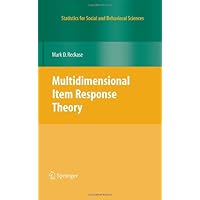
Multidimensional Item Response Theory (Statistics for Social and Behavioral Sciences) Review

Multidimensional Item Response Theory (Statistics for Social and Behavioral Sciences)
Average Reviews:

(More customer reviews)
The MIRT sub-field of psychometrics has for years labored in obscurity, due in no small part to the inability of its practitioners and students to understand each other and master each other's algorithms and models. Reckase, one of the field's leaders, takes a bold step in correcting the situation. Excellently researched, clearly written, logically presented, fair and balanced, Reckase summarizes the foundations of probabilistic unidimensional models and shows how they generalize, so that persons (test examinees) and items (test questions) can be represented as points (vectors) floating around in a multidimensional space.
This is not a book for the field practitioner or the casual researcher. It does not skip over the math, and the math is hard-core. Nonetheless, it is surprisingly readable. The reader will be pleased to find himself following the gist of Reckase's explanations without difficulty, even when the mathematical details are too much.
To appreciate this work, it is important to know why MIRT is important. Unfortunately, Reckase never tells us. We understand that MIRT is motivated by the fact that items and tests are complex, that they embody multiple dimensions, that therefore a multidimensional model is necessary. This hardly touches the surface. As the fantastic drama of the Netflix contest revealed (a recently resolved contest to win $1 m. for best predicting movie ratings), we live in a world of psychological profiling and prediction, a world populated by weird and incredible mathematical models that touch on every aspect of life -- from selecting food at Safeway, to renting movies, to profiling terrorists, to guiding teacher instructional decisions, to training computers to read and understand text and recognize the spoken word. None of that is in this book. The great divide between educational psychometrics and "data mining" or "knowledge discovery" has yet to be crossed. MIRT is the subfield within educational psychometrics that will ultimately bridge that divide.
On the theory side, Reckase does not conceal his differences with the "Rasch School" of psychometrics (of which I am a member) regarding the purpose of educational measurement and modeling, though he is obviously well-versed in Rasch models and presents them well, including their MIRT flavors. He sees the purpose of a model to be "descriptive" (to describe the data closely), whereas Rasch theorists see the purpose of a model to be "prescriptive" (to prescribe the conditions under which data yield true measures, i.e., measures that are most likely to reproduce across datasets regardless of person and item samples). The models that Reckase speaks about with the confidence of personal knowledge are "descriptive" in this sense.
Due perhaps to his preference for descriptive models, I found there were certain questions that Reckase did not seem to spend time on, questions that are huge for me:
1. How well do MIRT models handle small sample sizes?
2. How do they handle missing data, whether randomly or non-randomly missing?
3. To what degree are the person and item parameters invariant across samples? Can I cherry-pick my samples and get different parameters?
These are the sorts of questions Rasch people are always asking and where the Rasch model, properly used, has much to offer.
I also found myself looking in vain for discussion of Rasch's "specific objectivity" property as relates to MIRT, often called the "invariance" property. I learned that Reckase means something else entirely by the same word. In the Rasch world, "invariance" means that item and person parameters, and the resulting response probabilities, are invariant across samples, that persons will obtain the same relative measures regardless of what items they are administered so long as the items embody the same dimension. For Reckase, "invariance" means that the origin and orientation of the coordinate system can be moved without affecting the response probabilities. It's got nothing to do with samples. So, in the end, I still don't know what, if any, invariance properties the various MIRT models discussed in the book possess, defining "invariance" in the Rasch sense as invariance across person and item samples.

But those are my problems, not Reckase's. This book is a significant step forward in the maturation of an extraordinarily important, but little known, field.

Click Here to see more reviews about: Multidimensional Item Response Theory (Statistics for Social and Behavioral Sciences)

First thorough treatment of multidimensional item response theoryDescription of methods is supported by numerous practical examplesDescribes procedures for multidimensional computerized adaptive testing

Buy NowGet 45% OFF

Click here for more information about Multidimensional Item Response Theory (Statistics for Social and Behavioral Sciences)

Read More...

12/15/2011

Applied Bayesian Modeling and Causal Inference from Incomplete-Data Perspectives (Wiley Series in Probability and Statistics) Review

Applied Bayesian Modeling and Causal Inference from Incomplete-Data Perspectives (Wiley Series in Probability and Statistics)
Average Reviews:

(More customer reviews)
Professor Gelman has edited a book containing 29 articles dealing primarily with real applications of Bayesian methods for causal inference and the treatment of incomplete data.
It contains a collection of the best work in applied statistics by prominent statisticians. In addition to learning the wide variety of problems that have been solved using the Bayesian approach (particularly in the medical field) the reader can learn and appreciate the power and ease of interpretation of Bayesian results.

Click Here to see more reviews about: Applied Bayesian Modeling and Causal Inference from Incomplete-Data Perspectives (Wiley Series in Probability and Statistics)

This book brings together a collection of articles on statistical methods relating to missing data analysis, including multiple imputation, propensity scores, instrumental variables, and Bayesian inference. Covering new research topics and real-world examples which do not feature in many standard texts. The book is dedicated to Professor Don Rubin (Harvard). Don Rubin has made fundamental contributions to the study of missing data.
Key features of the book include:
Comprehensive coverage of an imporant area for both research and applications.
Adopts a pragmatic approach to describing a wide range of intermediate and advanced statistical techniques.
Covers key topics such as multiple imputation, propensity scores, instrumental variables and Bayesian inference.
Includes a number of applications from the social and health sciences.
Edited and authored by highly respected researchers in the area.


Buy NowGet 21% OFF

Click here for more information about Applied Bayesian Modeling and Causal Inference from Incomplete-Data Perspectives (Wiley Series in Probability and Statistics)

Read More...

10/25/2011

Probability, Markov Chains, Queues, and Simulation: The Mathematical Basis of Performance Modeling Review

Probability, Markov Chains, Queues, and Simulation: The Mathematical Basis of Performance Modeling
Average Reviews:

(More customer reviews)
This is the most succinct, clear mathematics book I have ever own. Unlike many mathematics books whose mathematical derivations usually have several missing yet important steps make people scratching their heads, this books is not one of them. All the derivations are very detailed along with great explanations and numerical examples. It is a rare gem in mathematical literature and I salute Prof. Stewart for his great achievement.

Click Here to see more reviews about: Probability, Markov Chains, Queues, and Simulation: The Mathematical Basis of Performance Modeling


Probability, Markov Chains, Queues, and Simulation provides a modern and authoritative treatment of the mathematical processes that underlie performance modeling. The detailed explanations of mathematical derivations and numerous illustrative examples make this textbook readily accessible to graduate and advanced undergraduate students taking courses in which stochastic processes play a fundamental role. The textbook is relevant to a wide variety of fields, including computer science, engineering, operations research, statistics, and mathematics.

The textbook looks at the fundamentals of probability theory, from the basic concepts of set-based probability, through probability distributions, to bounds, limit theorems, and the laws of large numbers. Discrete and continuous-time Markov chains are analyzed from a theoretical and computational point of view. Topics include the Chapman-Kolmogorov equations; irreducibility; the potential, fundamental, and reachability matrices; random walk problems; reversibility; renewal processes; and the numerical computation of stationary and transient distributions. The M/M/1 queue and its extensions to more general birth-death processes are analyzed in detail, as are queues with phase-type arrival and service processes. The M/G/1 and G/M/1 queues are solved using embedded Markov chains; the busy period, residual service time, and priority scheduling are treated. Open and closed queueing networks are analyzed. The final part of the book addresses the mathematical basis of simulation.

Each chapter of the textbook concludes with an extensive set of exercises. An instructor's solution manual, in which all exercises are completely worked out, is also available (to professors only).

Numerous examples illuminate the mathematical theories
Carefully detailed explanations of mathematical derivations guarantee a valuable pedagogical approach
Each chapter concludes with an extensive set of exercises

Professors: A supplementary Solutions Manual is available for this book. It is restricted to teachers using the text in courses. For information on how to obtain a copy, refer to: http://press.princeton.edu/class_use/solutions.html


Buy NowGet 30% OFF

Click here for more information about Probability, Markov Chains, Queues, and Simulation: The Mathematical Basis of Performance Modeling

Read More...

10/02/2011

Modeling Risk, + DVD: Applying Monte Carlo Risk Simulation, Strategic Real Options, Stochastic Forecasting, and Portfolio Optimization (Wiley Finance) Review

Modeling Risk, + DVD: Applying Monte Carlo Risk Simulation, Strategic Real Options, Stochastic Forecasting, and Portfolio Optimization (Wiley Finance)
Average Reviews:

(More customer reviews)
Dr Mun's books are always very insightful with lots of practical examples and tools. A very good book for the professional that needs an in depth understanding of risk management. The book provides many analytical tools to properly assess and mitigate risks!


Click Here to see more reviews about: Modeling Risk, + DVD: Applying Monte Carlo Risk Simulation, Strategic Real Options, Stochastic Forecasting, and Portfolio Optimization (Wiley Finance)

An updated guide to risk analysis and modeling
Although risk was once seen as something that was both unpredictable and uncontrollable, the evolution of risk analysis tools and theories has changed the way we look at this important business element. In the Second Edition of Analyzing and Modeling Risk, expert Dr. Johnathan Mun provides up-to-date coverage of risk analysis as it is applied within the realms of business risk analysis and offers an intuitive feel of what risk looks like, as well as the different ways of quantifying it.
This Second Edition provides professionals in all industries a more comprehensive guide on such key concepts as risk and return, the fundamentals of model building, Monte Carlo simulation, forecasting, time-series and regression analysis, optimization, real options, and more.
Includes new examples, questions, and exercises as well as updates using Excel 2007
Book supported by author's proprietary risk analysis software found on the companion CD-ROM
Offers both a qualitative and quantitative description of risk

Filled with in-depth insights and practical advice, this reliable resource covers all of the essential tools and techniques that risk managers need to successfully conduct risk analysis.
Note: CD-ROM/DVD and other supplementary materials are not included as part of eBook file.

Buy NowGet 33% OFF

Click here for more information about Modeling Risk, + DVD: Applying Monte Carlo Risk Simulation, Strategic Real Options, Stochastic Forecasting, and Portfolio Optimization (Wiley Finance)

Read More...