Showing posts with label quantitative finance. Show all posts

7/07/2012

Utility-Based Learning from Data (Chapman & Hall/CRC Machine Learning & Pattern Recognition) Review

Utility-Based Learning from Data (Chapman and Hall/CRC Machine Learning and Pattern Recognition)
Average Reviews:

(More customer reviews)
This book is just as great inside the cover as
the elegant cover leads you to expect.
A very ambitious book with a very broad scope.
As a Professor of Applied Mathematics and
of mathematical finance, I very much look
forward to presenting parts of this material
in the future.
Concerning the contents, citing from the introduction of
the book:"Our point of view is motivated by the notion that probabilistic models are
usually not learned for their own sake-rather, they are used to make decisions"
and "finance and decision theory provide a language in which it is
natural to express these assumptions-namely, utility theory-and formulate,
from first principals, model performance measures and the notion of optimal
and robust model performance"
and the books purpose is : " to provide a pedagogical and self-contained discussion of a select set of
methods for estimating probability distributions that can be approached
coherently from a decision-theoretic point of view"
The last sentence is extremely telling. Friedman and Sandow indeed
demonstrate in this book that, in struggling to quantify
default risk, in their daytime jobs at Standard and Poor's,
they carefully put into place their own approach, and painstakingly
tested it on read data, throughout many different economic
cycles (as far back as 2001, when I worked in Friedman's group).
In addition, after Friedman presented some of this material at
New York University's Courant Institute, Friedman and Sandow saw fit to
include a through introduction to topics which are of interest
to all economic students, such as utility theory and
minimum relative theory. And they do so in a crisp, clear and no-nonsense
manner that is rarely seen in books on economics.
A key aspect of the point of view taken in this book, is to relate
betting odds, such as in a horse race, to expected
growth of wealth.
Readers should race to the bookstore to get a
hold of this book!

Click Here to see more reviews about: Utility-Based Learning from Data (Chapman & Hall/CRC Machine Learning & Pattern Recognition)

Utility-Based Learning from Data provides a pedagogical, self-contained discussion of probability estimation methods via a coherent approach from the viewpoint of a decision maker who acts in an uncertain environment. This approach is motivated by the idea that probabilistic models are usually not learned for their own sake; rather, they are used to make decisions. Specifically, the authors adopt the point of view of a decision maker who(i) operates in an uncertain environment where the consequences of possible outcomes are explicitly monetized,(ii) bases his decisions on a probabilistic model, and(iii) builds and assesses his models accordingly.These assumptions are naturally expressed in the language of utility theory, which is well known from finance and decision theory. By taking this point of view, the book sheds light on and generalizes some popular statistical learning approaches, connecting ideas from information theory, statistics, and finance. It strikes a balance between rigor and intuition, conveying the main ideas to as wide an audience as possible.

Buy NowGet 19% OFF

Click here for more information about Utility-Based Learning from Data (Chapman & Hall/CRC Machine Learning & Pattern Recognition)

Read More...

6/02/2012

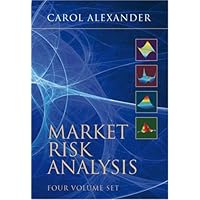
Market Risk Analysis Review

Market Risk Analysis
Average Reviews:

(More customer reviews)
This is a very good introduction on the subject of portfolio management. I bought these books as a mathematical engineer because I want to write my thesis about stock options. Everything is clearly explained, they even explain a lot of the easy mathematics you need to succeed in the world of finance. Every book contains a cd which is very handy if you want to calculate an option's price in a minute or something.
In my opinion there is not enough said in the book about options, but then again, it is a book to learn the basics. If you want to become a succesfull options trader, you do need more literature on the forecasting of volatility surfaces and backtesting of technical indicators etc.

Click Here to see more reviews about: Market Risk Analysis

Market Risk Analysis is the most comprehensive, rigorous and detailed resource available on market risk analysis. Written as a series of four interlinked volumes each title is self-contained, although numerous cross-references to other volumes enable readers to obtain further background knowledge and information about financial applications.
Volume I: Quantitative Methods in Finance covers the essential mathematical and financial background for subsequent volumes. Although many readers will already be familiar with this material, few competing texts contain such a complete and pedagogical exposition of all the basic quantitative concepts required for market risk analysis. There are six comprehensive chapters covering all the calculus, linear algebra, probability and statistics, numerical methods and portfolio mathematics that are necessary for market risk analysis. This is an ideal background text for a Masters course in finance.
Volume II: Practical Financial Econometrics provides a detailed understanding of financial econometrics, with applications to asset pricing and fund management as well as to market risk analysis. It covers equity factor models, including a detailed analysis of the Barra model and tracking error, principal component analysis, volatility and correlation, GARCH, cointegration, copulas, Markov switching, quantile regression, discrete choice models, non-linear regression, forecasting and model evaluation.
Volume III: Pricing, Hedging and Trading Financial Instruments has five very long chapters on the pricing, hedging and trading of bonds and swaps, futures and forwards, options and volatility as well detailed descriptions of mapping portfolios of these financial instruments to their risk factors. There are numerous examples, all coded in interactive Excel spreadsheets, including many pricing formulae for exotic options but excluding the calibration of stochastic volatility models, for which Matlab code is provided. The chapters on options and volatility together constitute 50% of the book, the slightly longer chapter on volatility concentrating on the dynamic properties the two volatility surfaces the implied and the local volatility surfaces that accompany an option pricing model, with particular reference to hedging.
Volume IV: Value at Risk Models builds on the three previous volumes to provide by far the most comprehensive and detailed treatment of market VaR models that is currently available in any textbook. The exposition starts at an elementary level but, as in all the other volumes, the pedagogical approach accompanied by numerous interactive Excel spreadsheets allows readers to experience the application of parametric linear, historical simulation and Monte Carlo VaR models to increasingly complex portfolios. Starting with simple positions, after a few chapters we apply value-at-risk models to interest rate sensitive portfolios, large international securities portfolios, commodity futures, path dependent options and much else. This rigorous treatment includes many new results and applications to regulatory and economic capital allocation, measurement of VaR model risk and stress testing.

Buy NowGet 21% OFF

Click here for more information about Market Risk Analysis

Read More...

4/09/2012

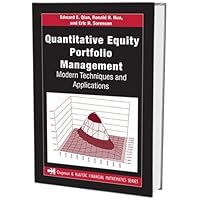
Quantitative Equity Portfolio Management: Modern Techniques and Applications (Chapman & Hall/CRC Financial Mathematics Series) Review

Quantitative Equity Portfolio Management: Modern Techniques and Applications (Chapman and Hall/CRC Financial Mathematics Series)
Average Reviews:

(More customer reviews)
Update after 1 month of reading:
(1) intially rated 4 stars, should be 5 stars (Good books are hard to find, language factor is minor)
(2) A serious Quant reader can gain a lot of insights from this book.
(3) Some of the discussions are way better than the other QEPM book(by Chincarini & Kim ). Although, this is half of the thickness.
(4) you need to be good with Linear Algebra. It is so much fun to see the authors use Linear equations to solve almost everything.
Short summary:
(1) Some advanced math background is needed (Linear Algebra mostly)
(2) Modern investment ideas are presented clearly.
(3) "Quant" book
(4) The Full 9 yards coverage from basic CAPM, alpha model, portfolio construction, trading and turnover, to attribution.
(5) the non-native author(s) should get some help on the writing.
This is an advanced book for quantitative analyst. On the surface, it does not require special math skills to read, which is nice. But to fully appreciate the ideas, you still need a lot of math background.
Most explanations are clean and easy to understand, even with the sometimes annoying writing skills.
Coverage of the modern investment ideas are quite comprehensive and to the right depth. Going deeper could risk more than 1000 pages, less will risk being superficial. There are certain areas in the investment industry that is not covered in this book, including automatic trading, pattern recognition, Bayesian based analysis, macro investing strategies, and alternative investment strategies. Lightly mentioned behavior finance.
Overall, still a good book to have.


Click Here to see more reviews about: Quantitative Equity Portfolio Management: Modern Techniques and Applications (Chapman & Hall/CRC Financial Mathematics Series)

Quantitative equity portfolio management combines theories and advanced techniques from several disciplines, including financial economics, accounting, mathematics, and operational research. While many texts are devoted to these disciplines, few deal with quantitative equity investing in a systematic and mathematical framework that is suitable for quantitative investment students. Providing a solid foundation in the subject, Quantitative Equity Portfolio Management: Modern Techniques and Applications presents a self-contained overview and a detailed mathematical treatment of various topics.From the theoretical basis of behavior finance to recently developed techniques, the authors review quantitative investment strategies and factors that are commonly used in practice, including value, momentum, and quality, accompanied by their academic origins. They present advanced techniques and applications in return forecasting models, risk management, portfolio construction, and portfolio implementation that include examples such as optimal multi-factor models, contextual and nonlinear models, factor timing techniques, portfolio turnover control, Monte Carlo valuation of firm values, and optimal trading. In many cases, the text frames related problems in mathematical terms and illustrates the mathematical concepts and solutions with numerical and empirical examples. Ideal for students in computational and quantitative finance programs, Quantitative Equity Portfolio Management serves as a guide to combat many common modeling issues and provides a rich understanding of portfolio management using mathematical analysis.

Buy NowGet 11% OFF

Click here for more information about Quantitative Equity Portfolio Management: Modern Techniques and Applications (Chapman & Hall/CRC Financial Mathematics Series)

Read More...

11/21/2011

Financial Modeling Under Non-Gaussian Distributions (Springer Finance) Review

Financial Modeling Under Non-Gaussian Distributions (Springer Finance)
Average Reviews:

(More customer reviews)
This book is an outstanding a clear presentation of non-Gaussian financial modeling. In financial markets, the Gaussian curve or bell curve, is not accurate in that most markets are skewed (a predisposition to grow on average, not zero) and fat-tailed (rare events such as market crashes happen more often than a Gaussian curve would suggest). Therefore, non-Gaussian modeling is essential to make money in the market or assess risk. This book goes through all the new techniques of non-Gaussian modeling. It does an exceptional job discussing the GARCH generalized autoregressive conditional heteroskedasticity. This is but a fancy word for fluctuations in volatility over time pretty much dependent on recent fluctuations. It works very well I must say empirically, and has tripled the rationality and profitability of my portfolio - especially one of the versions of the GARCH over the others reviewed - but which one I'd rather not say, for obvious reasons ;) The book is weakest at page 183 or so, with the models and I was rather disappointed with the exclusion of the market crash of the 80s in the empirical analysis - wouldn't rare events be the main reason for improving non-Gaussian modeling? Anyway it's rather poor, but thorough, with additive and multivariate GARCHes but the fault lies with the faultiness of the theories not the authors, at least they're encyclopedic. The book picks up at the end with copulas, and a complete discussion of non-Gaussian option pricing. The review of BSM is appreciated and actually well-done, and a nice reminder of what we are trying to improve on exactly. I think this is a most incredible book, very clearly written, and at times, quite an enjoyable read for such a topic. All it takes is multivariate calculus and basic statistics, but more math ability will make the implications and comments breathtaking at times. I often find myself inspired by a passage or footnote to create a whole subroutine in R or python. I think avoiding Bayesian topics and Monte Carlo was disappointing, but wise in terms of focus. A great book for graduate mathematics in applications of statistics or stochastic calculus, or a good book for modeling fundamentals in economics or business management at the post-graduate level.


Click Here to see more reviews about: Financial Modeling Under Non-Gaussian Distributions (Springer Finance)

This book examines non-Gaussian distributions. It addresses the causes and consequences of non-normality and time dependency in both asset returns and option prices. The book is written for non-mathematicians who want to model financial market prices so the emphasis throughout is on practice. There are abundant empirical illustrations of the models and techniques described, many of which could be equally applied to other financial time series.

Buy NowGet 20% OFF

Click here for more information about Financial Modeling Under Non-Gaussian Distributions (Springer Finance)

Read More...

10/01/2011

Interest Rate Modeling. Volume 1: Foundations and Vanilla Models Review

Interest Rate Modeling. Volume 1: Foundations and Vanilla Models
Average Reviews:

(More customer reviews)
About me: I am a trader in rates volatility and have a MS degree in MFE. I have only read the vol 1 of the 3 books so I am only reviewing the vol 1.
The book is more or less seperated into 2 parts: chap 1 to 5 are introductory materials for required math and numerical methods, and chap 6 to 9 are where things gets bit more technical and interesting. To me, if you want to get something out of this book you got to be comfortable with quants stuff, some basics like "Continuous time finance 2" from Shreve is required before you start this book. I found the material in chap6 to 9 interesting and instructive. There are many books about local and stochastic vols but I have yet to find any book that covered the material from head to toe like this book. The style of the writing is theory/proof/remark/example, and the derivations of the proof and formula is not too hard to follow, as long as you have the background as I mentioned before. The author also covered some important results from recent papers in the field, and talked about implementation challenges in numerical methods, which is very detail and I think it provides some coverage of the gap from theory to implementation. I'd love to read more about the details of what the banks used in their desks but I guess the authors would not expose what they really used at their work.
Overall this is a good book for quants. For traders I think vol 1 could be too technical and not much use because it does not cover the pricing and hedging of specific vol products, which is supposed to be in vol 3.

Click Here to see more reviews about: Interest Rate Modeling. Volume 1: Foundations and Vanilla Models

Table of contents for all three volumes (full details at andersen-piterbarg-book.com)Volume I. Foundations and Vanilla Models Part I. Foundations
Introduction toArbitrage Pricing Theory
Finite Difference Methods
Monte Carlo Methods
Fundamentals of Interest Rate Modelling
Fixed Income Instruments
Part II. Vanilla Models
Yield Curve Construction and Risk Management
Vanilla Models with Local Volatility
Vanilla Models with Stochastic Volatility I
Vanilla Models with Stochastic Volatility II
Volume II. Term Structure Models Part III. Term Structure Models
One-Factor Short Rate Models I
One-Factor Short Rate Models II
Multi-Factor Short Rate Models
The Quasi-Gaussian Model with Local and Stochastic Volatility
The Libor Market Model I
The Libor Market Model II
Volume III. Products and Risk Management Part IV. Products
Single-Rate Vanilla Derivatives
Multi-Rate Vanilla Derivatives
Callable Libor Exotics
Bermudan Swaptions
TARNs, Volatility Swaps, and Other Derivatives
Out-of-Model Adjustments
Part V. Risk management
Fundamentals of Risk Management
Payoff Smoothing and Related Methods
Pathwise Differentiation
Importance Sampling and Control Variates
Vegas in Libor Market Models
Appendix
Markovian Projection


Buy NowGet 10% OFF

Click here for more information about Interest Rate Modeling. Volume 1: Foundations and Vanilla Models

Read More...

9/09/2011

Interest Rate Modeling. Volume 3: Products and Risk Management Review

Interest Rate Modeling. Volume 3: Products and Risk Management
Average Reviews:

(More customer reviews)
I have read the vol 1 and vol 3. This review is for vol 3 only. After reading vol 1 (pls refer to my review for Vol 1) I was very impressed with the theoretical coverage and numerical tips, given by the authors who are probably the best quants on the street. Having this in mind I was expecting the same excitement and detail coverage for a wide range of vol products in vol 3. Now I have briefly finished reading vol 3, I have to say my feeling of vol 3 is mixed. I love the theortical treatment very well, the mapping in chap 16, the spread options in chap 17, the different improvements of regression in chap 18, the bermudans in 19, etc. The good thing is the subject is talked in detail with proofs and some implementation tips, and it is hard to find such material in other quant books. However, I feel something is missing. Some real trade examples maybe would fill some blanks. Just how to vega hedge a perticular CLE in real life, for example? I know there is no simple answer but would love to see how the big banks are doing it. I was expecting the authors discuss the hedging strategy for various type of vol products, 1 by 1, in detail, but I was a bit disappointed. Another pity I feel is the lack of discussion of forward vol and certain 2nd-order derivative profiles for the callables. Such as negative volga for accretor callables, I think every vol trader on the street knows this is ugly, however the authors didn't talk about it. Maybe the focus of this book is mainly about pricing models but not hedging/managing a vol book. Well, there are really too many things to cover I guess so can't expect a perfect book. Overall I would still highly recommend this book for quants and vol traders.

Click Here to see more reviews about: Interest Rate Modeling. Volume 3: Products and Risk Management

Table of contents for all three volumes (full details at andersen-piterbarg-book.com)Volume I. Foundations and Vanilla Models Part I. Foundations
Introduction toArbitrage Pricing Theory
Finite Difference Methods
Monte Carlo Methods
Fundamentals of Interest Rate Modelling
Fixed Income Instruments
Part II. Vanilla Models
Yield Curve Construction and Risk Management
Vanilla Models with Local Volatility
Vanilla Models with Stochastic Volatility I
Vanilla Models with Stochastic Volatility II
Volume II. Term Structure Models Part III. Term Structure Models
One-Factor Short Rate Models I
One-Factor Short Rate Models II
Multi-Factor Short Rate Models
The Quasi-Gaussian Model with Local and Stochastic Volatility
The Libor Market Model I
The Libor Market Model II
Volume III. Products and Risk Management Part IV. Products
Single-Rate Vanilla Derivatives
Multi-Rate Vanilla Derivatives
Callable Libor Exotics
Bermudan Swaptions
TARNs, Volatility Swaps, and Other Derivatives
Out-of-Model Adjustments
Part V. Risk management
Fundamentals of Risk Management
Payoff Smoothing and Related Methods
Pathwise Differentiation
Importance Sampling and Control Variates
Vegas in Libor Market Models
Appendix
Markovian Projection


Buy Now

Click here for more information about Interest Rate Modeling. Volume 3: Products and Risk Management

Read More...

8/21/2011

Interest Rate Modeling. Volume 2: Term Structure Models Review

Interest Rate Modeling. Volume 2: Term Structure Models
Average Reviews:

(More customer reviews)
I really find "Interest Rate Modeling" by Leif Andersen and Vladimir Piterbarg not only the best practical guide on interest rates derivatives modeling but also one of the best books on quantitative finance, in general. It is no wonder that many quants supporting asset classes other than interest rates derivatives bought this book as well. It is not only rigorous to ensure good understanding and giving the big picture but also very practical showing what would work in practice and what not, and how (using what tools) it can be achieved. Other books sometimes go on describing in details models that no one would ever use in practice just for the sake of completeness, or never discuss implementation details, which are the most important if the model is to be applied in practice (not mentioning curves building, Greeks and Risk Management). I am sure that every trading desk has already got a few copies of this book for reference: before it was a sharp need for a comprehensive interest rate derivatives book in practice like that. It is comprehensive because it methodologically covers all the components for successful understanding, development, and application of interest rates modeling in practice: mathematical and financial background (with tractable proofs and very useful references), the detailed description of traded interest rate derivatives, various practically applicable models (from basic to the most sophisticated) and numerical methods in a very systematic and consistent approach. I really recommend this book to everyone interested in quantitative finance: equally to academics (including students in financial engineering, mathematical finance etc) and practitioners.

Click Here to see more reviews about: Interest Rate Modeling. Volume 2: Term Structure Models

Table of contents for all three volumes (full details at andersen-piterbarg-book.com)Volume I. Foundations and Vanilla Models Part I. Foundations
Introduction toArbitrage Pricing Theory
Finite Difference Methods
Monte Carlo Methods
Fundamentals of Interest Rate Modelling
Fixed Income Instruments
Part II. Vanilla Models
Yield Curve Construction and Risk Management
Vanilla Models with Local Volatility
Vanilla Models with Stochastic Volatility I
Vanilla Models with Stochastic Volatility II
Volume II. Term Structure Models Part III. Term Structure Models
One-Factor Short Rate Models I
One-Factor Short Rate Models II
Multi-Factor Short Rate Models
The Quasi-Gaussian Model with Local and Stochastic Volatility
The Libor Market Model I
The Libor Market Model II
Volume III. Products and Risk Management Part IV. Products
Single-Rate Vanilla Derivatives
Multi-Rate Vanilla Derivatives
Callable Libor Exotics
Bermudan Swaptions
TARNs, Volatility Swaps, and Other Derivatives
Out-of-Model Adjustments
Part V. Risk management
Fundamentals of Risk Management
Payoff Smoothing and Related Methods
Pathwise Differentiation
Importance Sampling and Control Variates
Vegas in Libor Market Models
Appendix
Markovian Projection


Buy NowGet 11% OFF

Click here for more information about Interest Rate Modeling. Volume 2: Term Structure Models

Read More...