Showing posts with label decision theory. Show all posts

7/07/2012

Utility-Based Learning from Data (Chapman & Hall/CRC Machine Learning & Pattern Recognition) Review

Utility-Based Learning from Data (Chapman and Hall/CRC Machine Learning and Pattern Recognition)
Average Reviews:

(More customer reviews)
This book is just as great inside the cover as
the elegant cover leads you to expect.
A very ambitious book with a very broad scope.
As a Professor of Applied Mathematics and
of mathematical finance, I very much look
forward to presenting parts of this material
in the future.
Concerning the contents, citing from the introduction of
the book:"Our point of view is motivated by the notion that probabilistic models are
usually not learned for their own sake-rather, they are used to make decisions"
and "finance and decision theory provide a language in which it is
natural to express these assumptions-namely, utility theory-and formulate,
from first principals, model performance measures and the notion of optimal
and robust model performance"
and the books purpose is : " to provide a pedagogical and self-contained discussion of a select set of
methods for estimating probability distributions that can be approached
coherently from a decision-theoretic point of view"
The last sentence is extremely telling. Friedman and Sandow indeed
demonstrate in this book that, in struggling to quantify
default risk, in their daytime jobs at Standard and Poor's,
they carefully put into place their own approach, and painstakingly
tested it on read data, throughout many different economic
cycles (as far back as 2001, when I worked in Friedman's group).
In addition, after Friedman presented some of this material at
New York University's Courant Institute, Friedman and Sandow saw fit to
include a through introduction to topics which are of interest
to all economic students, such as utility theory and
minimum relative theory. And they do so in a crisp, clear and no-nonsense
manner that is rarely seen in books on economics.
A key aspect of the point of view taken in this book, is to relate
betting odds, such as in a horse race, to expected
growth of wealth.
Readers should race to the bookstore to get a
hold of this book!

Click Here to see more reviews about: Utility-Based Learning from Data (Chapman & Hall/CRC Machine Learning & Pattern Recognition)

Utility-Based Learning from Data provides a pedagogical, self-contained discussion of probability estimation methods via a coherent approach from the viewpoint of a decision maker who acts in an uncertain environment. This approach is motivated by the idea that probabilistic models are usually not learned for their own sake; rather, they are used to make decisions. Specifically, the authors adopt the point of view of a decision maker who(i) operates in an uncertain environment where the consequences of possible outcomes are explicitly monetized,(ii) bases his decisions on a probabilistic model, and(iii) builds and assesses his models accordingly.These assumptions are naturally expressed in the language of utility theory, which is well known from finance and decision theory. By taking this point of view, the book sheds light on and generalizes some popular statistical learning approaches, connecting ideas from information theory, statistics, and finance. It strikes a balance between rigor and intuition, conveying the main ideas to as wide an audience as possible.

Buy NowGet 19% OFF

Click here for more information about Utility-Based Learning from Data (Chapman & Hall/CRC Machine Learning & Pattern Recognition)

Read More...

8/31/2011

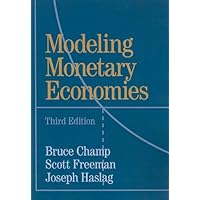
Modeling Monetary Economies Review

Modeling Monetary Economies
Average Reviews:

(More customer reviews)
Economists have a responsiblity to communicate as simply as possible. Too often complex mathematics are an egotistic tool of the economist that merely frustrates the reader. Champ and Freeman's Modeling Monetary Economies is a wonderful volume that explains tough issues in monetary economics by building upon Wallace and Bryant's overlapping generations (OLG) model.
The OLG framework is a very simple framework that has its limitations, yet it is a powerful explanatory device. Champ and Freeman apply it to the following exercises:
* Introduce money into an economy--any grad student of economics (as I once was) will tell you this is no simple task! We take money for granted, of course, but mathematical models tend to imply that money is unnecessary! Just getting money into an economic model without unreasonable assumptions is itself an accomplishment.
* Inflation--again, not easy to do in other mathematical models of money--and anticipated inflation
* International currency exchange and the indeterminancy of the exchange rate
* Central banking and changes to the money supply
* Banks and lending
* Deficits and the national debt
* The interaction of all of the above
The book also has exercises in it that apply and extend the models introduced in each chapter.
RECOMMENDATION
I recommend this book for advanced year undergrads (in mathematical econ programs) and graduate students. It really is a great book that builds a conceptual knowledge of the interaction of the various components of monetary economics. This is useful for understanding more complicated dynamic optimization models. And it provides models that are useful in their own right and relevant as the basis for further (ie., dissertation) research.

Click Here to see more reviews about: Modeling Monetary Economies

The approach of this text is to teach monetary economics using the classical paradigm of rational agents in a market setting. Too often monetaryeconomics has been taught as a collection of facts about existing institutions for students to memorize. By teaching from first principles instead, the authors aim to instruct students not only in the monetary policies and institutions that exist today in the United States and Canada, but also in what policies and institutions may orshould exist tomorrow and elsewhere. The text builds on a simple, clear monetary model and applies this framework consistently to a wide variety of monetary questions. The authors have added in this third edition new material on money as a means of replacing imperfect social record keeping, the role of currency inbanking panics, and a description of the policies implemented to deal with the banking crises that began in 2007.

Buy NowGet 18% OFF

Click here for more information about Modeling Monetary Economies

Read More...