Showing posts with label excel modeling. Show all posts

7/24/2012

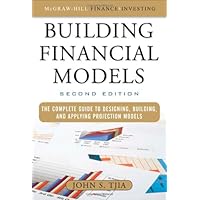
Building Financial Models (McGraw-Hill Finance & Investing) Review

Building Financial Models (McGraw-Hill Finance and Investing)
Average Reviews:

(More customer reviews)
Fantastic financial modeling book! This should be the text (or at least supplemental) for any serious corporate finance or financial modeling class. I wish it would've been metioned in my MBA classes.
The book covers basics of Excel and accounting so you don't need to be an expert on either subject.
The *best* part are the highly-detailed, step-by-step, in-depth models that show the reader how to:
(1) Link the balance sheet, income statement, and statement of cash flows
(2) Repay debt via cash sweep
(3) Make a dynamic model financial model that can be applied to many situations
I have several financial modeling books, a couple of them are very good. This book is peerless as it walks the reader through the modeling process, from beginning to end.
I highly recommend it.
JB

Click Here to see more reviews about: Building Financial Models (McGraw-Hill Finance & Investing)


The ability to effectively create and interpret financial models is one of the most valued skills in corporate finance--from Wall Street to Main Street. Now, the acclaimed guide to designing, building, and implementing valuation projection models is fully revised and expanded to keep finance and accounting professionals competitive in today's marketplace.

This second edition of Building Financial Models continues the tradition of its predecessor by providing a hands-on approach to creating a core model that is supported by broad coverage of cornerstone accounting and finance principles. Additionally, this updated volume features:
Entirely new coverage of discounted cash flow (DCF) modeling
Excel formulas for making powerful calculations within the spreadsheet
In-depth explanations of both the principles and mechanics of projection models

Building Financial Models helps readers practice good thinking and apply sound knowledge of their tools--two key attributes to producing robust and easy-to-use models. This practical guide takes you step by step through the entire process of developing a projection model, with a full chapter dedicated to each phase. By the end, you will have a working, dynamic spreadsheet financial model for making projections for industrial and manufacturing companies.

Furthermore, this Second Edition provides the vocabulary and syntax of model building so you can tailor core models to fit any size company and allow for quick input changes to test sensitivity. The companion website www.buildingfinancialmodel.com offering example spreadsheets will give you a head start on developing your own models.

A flexible and successful financial projection model does more than just add numbers--it explains the complex relationships between those numbers and illuminates ways to use those associations to add value to an enterprise. Building Financial Models is the only book you need to create and implement a fluid financial projection model that is both state of the art and user friendly.


Buy NowGet 24% OFF

Click here for more information about Building Financial Models (McGraw-Hill Finance & Investing)

Read More...

12/11/2011

Financial Modelling in Practice: A Concise Guide for Intermediate and Advanced Level (The Wiley Finance Series) Review

Financial Modelling in Practice: A Concise Guide for Intermediate and Advanced Level (The Wiley Finance Series)
Average Reviews:

(More customer reviews)
Michael Rees succeeds to a large extent in his endeavor of writing a text that addresses the financial modeling process instead of Excel functionality, financial theory, or mathematical models. To his credit, Rees has put together a large number of useful modeling examples in the CD-ROM that is sold with the text. Rees' book assumes that readers have at least an intermediate knowledge of both statistical and financial concepts.
After reviewing select Excel functions and tools relevant to financial modeling, Rees gives his audience of modelers many practical tips about how to design, structure, and build models that are relevant, accurate, and easily understandable. Whoever has experience with models will probably agree with Rees when he writes that the majority of models built are in practice of mediocre quality. Someone other than the author of the model will often experience several challenges in dealing with the model at hand, i.e., too much time spent on understanding the model, complexity of the auditing and validating processes, hard to share with others, over-reliance on the original modeler to maintain or use it, lack of clarity of objectives, and presence of errors and implicit assumptions.
Rees then goes into the modeling of financial statements that is often required in the world of corporate finance for forecasting profit and cash, assessing financing requirements, analyzing credit risk and valuation, etc. This chapter is a little gem. It contains many practical tips. Once again, readers will be reminded that there is not always 100% agreement on the definition of some financial concepts.
Rees then uses Palisade Corporation's add-ins @RISK and PrecisionTree for many modeling examples in the two chapters that he dedicates to risk modeling and real option modeling, respectively. Having some understanding of both statistical and financial concepts is particularly important here to benefit from reading both chapters. Probably, many readers with an advanced knowledge of Excel 2007 will regret that the above-mentioned functionality that Palisade Corporation offers has not yet been systematically integrated into at least Microsoft Office Professional.
Finally, Rees discusses the use of Visual Basic for Applications (VBA) in a range of practical financial modeling situations. Rees points out that many otherwise competent modelers never learn VBA. For this reason, Rees makes the assumption that his audience is not very familiar with VBA. Rees shows how macros, i.e., subroutines and user-defined functions, can be used in a variety of modeling contexts.
In conclusion, Rees has made a valuable contribution to the field of financial modeling. The CD-ROM that is sold with the text plays a key role in achieving this objective.


Click Here to see more reviews about: Financial Modelling in Practice: A Concise Guide for Intermediate and Advanced Level (The Wiley Finance Series)

Financial Modelling in Practice: A Concise Guide for Intermediate and Advanced Level is a practical, comprehensive and in-depth guide to financial modelling designed to cover the modelling issues that are relevant to facilitate the construction of robust and readily understandable models.
Based on the authors extensive experience of building models in business and finance, and of training others how to do so this book starts with a review of Excel functions that are generally most relevant for building intermediate and advanced level models (such as Lookup functions, database and statistical functions and so on). It then discusses the principles involved in designing, structuring and building relevant, accurate and readily understandable models (including the use of sensitivity analysis techniques) before covering key application areas, such as the modelling of financial statements, of cash flow valuation, risk analysis, options and real options. Finally, the topic of financial modelling using VBA is treated. Practical examples are used throughout and model examples are included in the attached CD-ROM.
Aimed at intermediate and advanced level modellers in Excel who wish to extend and consolidate their knowledge, this book is focused, practical, and application-driven, facilitating knowledge to build or audit a much wider range of financial models.
Note: CD-ROM/DVD and other supplementary materials are not included as part of eBook file.

Buy NowGet 43% OFF

Click here for more information about Financial Modelling in Practice: A Concise Guide for Intermediate and Advanced Level (The Wiley Finance Series)

Read More...

8/24/2011

Simulation and Optimization in Finance + Website: Modeling with MATLAB, @Risk, or VBA (Frank J. Fabozzi Series) Review

Simulation and Optimization in Finance + Website: Modeling with MATLAB, @Risk, or VBA (Frank J. Fabozzi Series)
Average Reviews:

(More customer reviews)
Prof.Pachamanova has written one of the best introductions to Simulation and Optimization methods in finance. This book provides a strong theoretical foundation and the website provides a lot of cases and useful hands-on exercises to apply and understand the concepts explained in the book. This book is highly recommended for business and engineering students who are interested in a career in the quantitative finance industry. This book is also recommended to new entrants to the quant finance industry and to financial practitioners who primarily use Excel for quantitative modeling but are interested in building more rigorous models using VBA, @RISK and MATLAB.
This book has the optimal combination of theory and practice. It starts out with a through introduction to statistics, finance and optimization concepts. In the second part, the book describes portfolio optimization theory and applications in equity and fixed income markets. The third part focuses on asset pricing models discussing classical and dynamic models. The fourth section mainly focuses on derivative pricing and provides a very good introduction to Monte-Carlo simulation methods. Topics of current interest such as pricing MBS products are also described in this section. Part five focuses on capital budget decisions and has a very good introduction to real options. The Software hints in each chapter and the supplementary materials on the website help students and practitioners to immediately try out examples and fortify their knowledge.
Prof.Pachamanova's didactic approach and the vast coverage of topics makes this book a must have for new quantitative analysts, business students and engineers interested in a career in finance. As a Financial Modeling consultant who works at MathWorks (the maker of MATLAB), I get a lot of questions on recommendations for books to apply financial theory using computational tools. This book is a gem and would makes great addition to your quantitative investing library.
Full Disclosure: I took a Statistics class with Prof.Pachamanova during my MBA program at Babson College

Click Here to see more reviews about: Simulation and Optimization in Finance + Website: Modeling with MATLAB, @Risk, or VBA (Frank J. Fabozzi Series)

An introduction to the theory and practice of financial simulation and optimization
In recent years, there has been a notable increase in the use of simulation and optimization methods in the financial industry. Applications include portfolio allocation, risk management, pricing, and capital budgeting under uncertainty.
This accessible guide provides an introduction to the simulation and optimization techniques most widely used in finance, while at the same time offering background on the financial concepts in these applications. In addition, it clarifies difficult concepts in traditional models of uncertainty in finance, and teaches you how to build models with software. It does this by reviewing current simulation and optimization methodology-along with available software-and proceeds with portfolio risk management, modeling of random processes, pricing of financial derivatives, and real options applications.
Contains a unique combination of finance theory and rigorous mathematical modeling emphasizing a hands-on approach through implementation with software
Highlights not only classical applications, but also more recent developments, such as pricing of mortgage-backed securities
Includes models and code in both spreadsheet-based software (@RISK, Solver, Evolver, VBA) and mathematical modeling software (MATLAB)

Filled with in-depth insights and practical advice, Simulation and Optimization Modeling in Finance offers essential guidance on some of the most important topics in financial management.

Buy NowGet 37% OFF

Click here for more information about Simulation and Optimization in Finance + Website: Modeling with MATLAB, @Risk, or VBA (Frank J. Fabozzi Series)

Read More...

8/04/2011

Excel Modeling &_Estimation in Corporate Finance (2008 publication) Review

Excel Modeling and_Estimation in Corporate Finance (2008 publication)
Average Reviews:

(More customer reviews)
I am a huge fan of this book for several reasons. First, I believe that Professor Holden is absolutely right in trying to move finance from a calculator driven study to spreadsheets. Everyone uses spreadsheets in their work, NOT calculators. So, it is not only useful to use spreadsheets, but to learn how to build them.
Another very nice thing about this book is that it uses plain vanilla Excel. You don't need any special add-ins. This allows the user to understand what Excel on its own is capable of (and that is quite a bit). It also means the student doesn't have to buy anything more than this book to get everything the author intended.
I also like the way he takes the student along. You build the first spreadsheet with the steps he provides, and then you modify that to make the second, and then the third, and so on. You get to see the increasingly powerful things one can do with Excel. The graphs he has one build also help because it allows you to change different values and immediately see how it changes the graph. This is immensely important in helping the student develop intuitions about how the changing of this or that number affects the topic of the spreadsheet.
This book on corporate finance begins with the time value of money, a basic concept, but one that seems to elude any number of people. Part 2 takes the student into the valuation of bonds and stocks. You also get to build a yield curve (very useful) and US yield curve dynamics. Part 3 is Capital Budgeting and this means Project Net Present Value (NPV), Cost-Reducing Project, Break-Even Analysis, Adjusted Present Value, Flows to Equity, and WACC.
Part 4 takes on topics of financial planning such as Corporate Financial Planning, the Du Pont System of Ratio Analysis, and Life-Cycle Financial Planning. The last part, Part 5 deals with options and corporate finance. You get to build spreadsheets for Binomial Option Pricing, Black Scholes Option Pricing, Debt and Equity Valuation, and Real Options.
While the book uses the Brigham text notation, the accompanying CD has several important chapters with the Brealy, Keown, Ross, and Van Horne notation systems. The CD also supplies databases and problems to solve using the spreadsheets. The author also has a website for additional info and updates.
Terrific book for finance classes or as a supplement to your own study.

Click Here to see more reviews about: Excel Modeling &_Estimation in Corporate Finance (2008 publication)


Buy Now

Click here for more information about Excel Modeling &_Estimation in Corporate Finance (2008 publication)

Read More...

8/02/2011

Next Generation Excel: Modeling in Excel for Analysts and MBAs (Wiley Finance) Review

Next Generation Excel: Modeling in Excel for Analysts and MBAs (Wiley Finance)
Average Reviews:

(More customer reviews)
I heartily recommend this book to anyone that uses Excel on a daily basis for business analysis or for MBA students. Early in the introduction, Dr. Gottlieb promises that if you use Excel for 10 hours a week or more, this book will save you hundreds of hours per year. He delivers!
You don't need to build an excel spreadsheet to calculate that this book is worth many times its cover price to users of excel. Even if you are a "power user" you will quiclky find tips that will make you more efficient.
I was fortunate enough to take an Excel class from Dr. Gottlieb a few years ago during the "crash math course" week while getting an MBA at Columbia University. I don't want to offend any of my esteemed professors, but those few hours with Dr. Gottlieb were probably more useful than several of my semester-long courses to me. I currently use Excel for 3-4 hours per day to analyze stocks at my hedge fund and his tips have saved me hours and helped to make my graphical representation of data look top-notch.
This book is not a basic "how-to" or "for dummies" book on Excel. It is the perfect book for you if you use Excel frequently, but are frustrated that you have to perform certain repetitive keystrokes or clicks to get it do what you want. Perhaps you want your charts to look better. Maybe you didn't even know that you could have custom lists built in, for example, instead of manually entering FQ01, FQ02, etc. You can add trend lines to graphs; you can format parts of graphs differently than other parts. You can name cells, groups of cells to make your work easier.
Dr. Gottlieb exposes the many keystroke shortcuts that can make your daily grind with Excel less laborious. His book is laid out in a very concise, neat organization. I think the best way to really benefit from it is to power through entire sections that apply to your work and try his examples. He provides some problems at the end of each chapter (he is in academia, after all) but mercifully; he provides the answers, too!
This book is only about 280 pages long, but don't let that fool you, if you compare it to some other Excel books with 800 pages. He has more time-saving information in it than books 2 or 3 times as long. The beauty of his book is everything he shows is something an analyst using Excel in the real world actually uses it for. He is not just running through every menu, detailing every useless capability of Excel, like the other books.
This is the key advantage to Dr. Gottlieb's book. He has a list of over 50,000 people that he sends his "tip of the month" to and they (like me) are not shy about emailing him questions. This gives him keen insight into what real Excel jockeys are interested in, and he addresses those issues in this book. Get it today and you will discover many things that Excel can do for you, in a much easier way than you are using it today!

Click Here to see more reviews about: Next Generation Excel: Modeling in Excel for Analysts and MBAs (Wiley Finance)

Dr. Isaac Gottlieb personally trained 35 of our top analysts and finance professionals in a customized advanced Excel seminar. Many of the tools covered in this book were part of this well-received training. For the past five years, Isaac's monthly Excel-Tip-Of-The-Month newsletter has been a personal favorite of mine. In an age where email overload is common, I always look forward to his email and many of my associates and team members around the world are part of his over 50,000 monthly recipients. This compilation is a must-have for any finance professional who wants to be a better business partner and truly add value in a more efficient manner!
Anthony N. Caspio, CMAVice President - FinanceSealed Air Corporation
Excel has been one of the most powerful applications of recent times, but most users, unfortunately, only scratch its surface. Prof. Gottlieb's book leverages his years of Excel workshops in the US, Europe and Asia, and he unleashes the tremendous potential and power of Excel. His to-the-point explanations and his innovative screenshots bring Excel alive to readers who may just have a working knowledge of the software. This amazing volume is an application-oriented book for Excel users who want answers fast, and who need to maximize the application's awesome potential.
Prof. Farrokh Langdana, Ph.D.Director, Rutgers Executive MBAProfessor, Rutgers Business School
If I should thank Microsoft for inventing Excel, then I would like to thank Dr. Isaac Gottlieb more for teaching me how to use it to solve the real problems in my real work. Keep going Isaac!
Wu HaowenDirector of International ProgramsSchool of Management, Dalian University of Technology
Isaac Gottlieb's Next Generation Excel is an invaluable resource. The fruit of many years of teaching Excel to university business students, Gottlieb's book covers the topics that the Excel user needs to become more efficient and sophisticated. It is easy to read and follow. A wonderful book!
Simon BenningaProfessor of Finance, Faculty of Management, Tel Aviv UniversityAuthor of Principles of Finance with Excel
As an avid user of Excel, several years ago I came across Isaac's Excel-Tip-Of-The-Month newsletter. I quickly realized that Isaac exploits Excel to the "next usability level." Like his monthly newsletters, Isaac has composed a book that is clear and concise similarly reflecting his teaching methods. This book helps intermediate users to rapidly acquire Excel-pro skills, while allowing advanced users to grasp concepts in one single pass-through. Furthermore, Isaac takes day-to-day challenges and provides elegant ease of use solutions.
Moshe CastielManager, IT – Technology & OperationsTIAA-CREF
Next Generation Excel presents an interesting perspective on the resourcefulness of Microsoft Excel like never before. This book is an excellent and a much-needed resource to MBA students, educators and Excel enthusiasts. In reviewing this book, the principal criteria included content, organization and Excel add-on files. The book is neatly organized into sections; starting with basic Excel tools and functions, commonly used statistical tools, what-if-analysis and then moving on to advanced data features, solver-add ins and various other ToolPaks, nicely complemented with the Excel snapshots to provide a user friendly experience. As a result, one can jump directly to the relevant sections and use the Excel files provided to get a more hands-on experience. The right mix of theory and practice, is the unique selling point (USP) of this book!
Anirudha "Andy" Vaidya, MBACEOAVS System

Buy NowGet 37% OFF

Click here for more information about Next Generation Excel: Modeling in Excel for Analysts and MBAs (Wiley Finance)
Read More...

8/01/2011

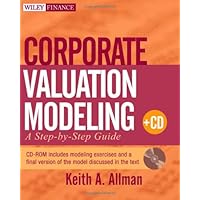
Corporate Valuation Modeling: A Step-by-Step Guide (Wiley Finance) Review

Corporate Valuation Modeling: A Step-by-Step Guide (Wiley Finance)
Average Reviews:

(More customer reviews)
There are many different variations on the basic DCF valuation model. Every bank has one, every business school has one, and everyone modifies it for their own purposes.
Keith's book offers some distinct advantages: (1) It actually walks you through the steps of building the model, instead of simply typing the inputs into one. This will ensure you understand it, but it might take some time to build it. (The full model is included for people who want to skip the typing). (2) Secondly, it is a "full blown" model and not a simplified version of one. While the first is common, and the second is common, the combination is (in my experience) uncommon.
More interestingly, (3) this model is more advanced than most of the others out there. The primary improvement is he has more "checks and balances" thrown in. The model has little checks that make sure cash ties through, that the extra cash pays off the debt, that capital expenditures are accounted for and that their depreciation pours through the income statement etc. This is invaluable. It does make it complicated, and sometimes I had circular references that were hard to fix, but this just forced me to deal with what was really going on in the model.
All in all, nicely done.

Click Here to see more reviews about: Corporate Valuation Modeling: A Step-by-Step Guide (Wiley Finance)

A critical guide to corporate valuation modeling
Valuation is at the heart of everything that Wall Street does. Every day, millions of transactions to purchase or sell companies take place based on prices created by the activities of all market participants. In this book, author Keith Allman provides you with a core model to value companies.
Corporate Valuation Modeling takes you step-by-step through the process of creating a powerful corporate valuation model. Each chapter skillfully discusses the theory of the concept, followed by Model Builder instructions that inform you of every step necessary to create the template model. Many chapters also include a validation section that shows techniques and implementations that you can employ to make sure the model is working properly.
Walks you through the full process of constructing a fully dynamic corporate valuation model
A Tool Box section at the end of each chapter assists readers who may be less skilled in Excel techniques and functions

Complete with a companion CD-ROM that contains constructed models, this book is an essential guide to understanding the intricacies of corporate valuation modeling.
Note: CD-ROM/DVD and other supplementary materials are not included as part of eBook file.

Buy NowGet 37% OFF

Click here for more information about Corporate Valuation Modeling: A Step-by-Step Guide (Wiley Finance)

Read More...