Showing posts with label valuation. Show all posts

3/10/2012

Equity Valuation for Analysts and Investors Review

Equity Valuation for Analysts and Investors
Average Reviews:

(More customer reviews)
If you ever wanted to know how the pros on Wall St. develop earnings estimates then this is the book for you. Jim Kelleher takes you step by step so that you can build a model on your own. While "there are many ways to skin a cat", Jim walks the reader through how he develops intricate earnings and valuation models that he has perfected over decades in the industry. This is a great book for beginners and professionals alike.

Click Here to see more reviews about: Equity Valuation for Analysts and Investors


Create comprehensive stock valuation models--quickly and efficiently
"This amazingly thorough book takes you through real-world financial modeling, provides concise techniques and methods for determining asset value, and offers a blended valuation approach that is responsive to changes inmarket dynamics. Peer Derived Value, introduced in the book, represents an original and commonsense approach to valuing a stock within its peer group. This book, in my view, is an invaluable addition to any investor'slibrary." -- William V. Campbell, Chairman, Intuit Corporation
Equity Valuation for Analysts and Investors introduces you to the financial statement analysis and model-building methodology used by leading equity research firm Argus Research. Written by Jim Kelleher, the company's director of research, the book offers thetools for estimating individual equity cash value. These include a completely original and proprietary valuation methodology, Peer Derived Value, which values an equity based on the stock's current variation from its historical relation to a user-specifi ed peer group.
In a conveniently organized format, this in-depth guide covers all the tasks you need to master, including:• Financial statement modeling • Comparables analysis• Discounted free cash fl ow • Industry matrix models• Blending valuation inputs to calculate fair value in any market environment
Valuing and predicting the future value of assets and stocks is a laborious task. Successful analysts andinvestors don't have time for tedious work that is outdated as soon as it's done.
Equity Valuation for Analysts and Investors isthe comprehensive guide to efficient financialstatement analysis and model-building from one of the world-leading independent equity research firms, Argus Research.
At the helm of the company's research is author Jim Kelleher, who developed his methodology and model-building techniques during his twenty years covering more thana dozen industries in nearly every sector. A good valuation model is an invaluable tool to help the serious investor:
Wring more information from the 10-K and 10-Q
Predict unexpected earnings shortfall or positive earnings surprises
Master the art of "valuation choreography"

One of the biggest challenges to making accurate predictions with a valuation model today is the rapid and constant fluctuation of data. Equity Valuation for Analysts and Investors provides a tried-and-true process for creating effective, compact models that add newmeasurement and valuation periods and accommodate a company's unique data presentation and reporting style.
This versatile guidebook also provides both a rigorous process and a shortcut for each step in modeling financial statement data so analysts can customize their data focus based on their position in the value chain. When implemented in the real world, the valuation model uses thepower of Excel to allow investors to quickly and accurately update their valuations and predictions by simply inputting adjusted data.
Take control of your investments now by managing them based on your own research and Equity Valuation for Analysts and Investors.

Buy NowGet 27% OFF

Click here for more information about Equity Valuation for Analysts and Investors

Read More...

8/27/2011

Excel Modeling and Estimation in Investments Review

Excel Modeling and Estimation in Investments
Average Reviews:

(More customer reviews)
Craig W. Holden's "Excel Modeling in Investments" came as an excellent surprise to me when I received a faculty review copy from the publisher. I have long used Simon Benninga's competing text "Financial Modeling in Excel" to teach undergraduate and graduate financial modeling courses, however, I seriously am considering switching to Holden's EMinI. Holden correctly emphasizes discounting a bond's value on various yield curves, rather than a linear or fixed discount rate as in Benninga. Holden has some flaws, his layouts for binomial pricing models are inefficient for adapting to trinomial converging tree models, for example, but Holden is the only serious rival to Benninga in coverage of the major topics of modeling. Holden covers bonds, duration, convexity, portfolio optimization, financial planning, and the leading option pricing models. In addition, he covers cost of carry in the context of spot and futures prices, and interest rate parity. Holden does not cover Value at Risk, cheapest to deliver bonds, and has little on Visual Basic. However he does cover the Vasicek and Cox-Ingersoll-Ross interest rate models more thoroughly than Benninga. Holden's flaws are many: there is no index, and this is a text that cries out for one. Similarly, the footnotes are inadequate, and a broad "Further Reading" and bibliography should be here. Holden also suffers from being written as a companion text to popular finance textbooks such as Bodie Kane and Marcus, however, one always has the impression that the author was looking more to maximizing the market share of the text than really selecting the best chapters. We can only hope that Holden follows the better angels of his nature and includes more detail and chapters, perhaps on Monte Carlo simulation, VaR, and VBA programming. The CD-Rom, while helpful, is a little light, but this is the author's intention for he wishes students to build their own models from scratch.
In summary, I heartily recommend this book coupled with Benninga's more detailed "Financial Modeling in Excel" and find the practical emphasis indispensable for those working with or using a theoretical text such as Bodie Kane and Marcus. For those students that want careers in finance, this book is fundamental, primary, and necessary, for it emphasizes practical skills you will be executing everyday at a much higher level in a bank or asset management firm. Master these skills and models now before beginning your career and the acceleration of your promotions responsibilities will exceed those of your peers quickly.

Click Here to see more reviews about: Excel Modeling and Estimation in Investments


Buy Now

Click here for more information about Excel Modeling and Estimation in Investments

Read More...

8/01/2011

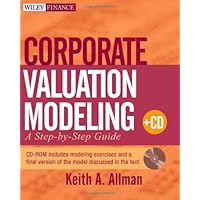
Corporate Valuation Modeling: A Step-by-Step Guide (Wiley Finance) Review

Corporate Valuation Modeling: A Step-by-Step Guide (Wiley Finance)
Average Reviews:

(More customer reviews)
There are many different variations on the basic DCF valuation model. Every bank has one, every business school has one, and everyone modifies it for their own purposes.
Keith's book offers some distinct advantages: (1) It actually walks you through the steps of building the model, instead of simply typing the inputs into one. This will ensure you understand it, but it might take some time to build it. (The full model is included for people who want to skip the typing). (2) Secondly, it is a "full blown" model and not a simplified version of one. While the first is common, and the second is common, the combination is (in my experience) uncommon.
More interestingly, (3) this model is more advanced than most of the others out there. The primary improvement is he has more "checks and balances" thrown in. The model has little checks that make sure cash ties through, that the extra cash pays off the debt, that capital expenditures are accounted for and that their depreciation pours through the income statement etc. This is invaluable. It does make it complicated, and sometimes I had circular references that were hard to fix, but this just forced me to deal with what was really going on in the model.
All in all, nicely done.

Click Here to see more reviews about: Corporate Valuation Modeling: A Step-by-Step Guide (Wiley Finance)

A critical guide to corporate valuation modeling
Valuation is at the heart of everything that Wall Street does. Every day, millions of transactions to purchase or sell companies take place based on prices created by the activities of all market participants. In this book, author Keith Allman provides you with a core model to value companies.
Corporate Valuation Modeling takes you step-by-step through the process of creating a powerful corporate valuation model. Each chapter skillfully discusses the theory of the concept, followed by Model Builder instructions that inform you of every step necessary to create the template model. Many chapters also include a validation section that shows techniques and implementations that you can employ to make sure the model is working properly.
Walks you through the full process of constructing a fully dynamic corporate valuation model
A Tool Box section at the end of each chapter assists readers who may be less skilled in Excel techniques and functions

Complete with a companion CD-ROM that contains constructed models, this book is an essential guide to understanding the intricacies of corporate valuation modeling.
Note: CD-ROM/DVD and other supplementary materials are not included as part of eBook file.

Buy NowGet 37% OFF

Click here for more information about Corporate Valuation Modeling: A Step-by-Step Guide (Wiley Finance)

Read More...