Showing posts with label process improvement. Show all posts

5/25/2012

Military Operations Research: Quantitative Decision Making (International Series in Operations Research & Management Science) Review

Military Operations Research: Quantitative Decision Making (International Series in Operations Research and Management Science)
Average Reviews:

(More customer reviews)
Jaiswal provides the most recent land power-focused military operations research volume. He provides a basic survey of the field, beginning with a very brief discussion of the origins of OR in the military. His topics include search and detection, military simulation, cost effectiveness analysis, optimization, the Analytic Hierarchy Process, Lanchester equations, and a quantified approach to intelligence analysis. The reader should be aware that his coverage of various specific military simulation models is a bit dated, as one should expect in a book, and limited in scope. Beyond that topic, his treatment is broad and therefore less sensitive to the passage of time. The book is a survey, so depth of treatment is not present. But it fills the intended role of pulling together disparate topics of land-based military OR. It also provides some perspective on non NATO defense issues. It must be challenging to decide what to exclude, but surprisingly there is no coverage of network flows, queuing theory, decision analysis, or game theory which have clear military applications. The focus is also on operations rather than the logistics of military analysis.

Click Here to see more reviews about: Military Operations Research: Quantitative Decision Making (International Series in Operations Research & Management Science)

The field of Operations Research (OR) grew out of World War IIoperations to improve the effectiveness of newly introduced weaponsand equipment, and to solve logistical problems for the war effort.Since its beginnings, OR has rapidly become a robust set ofdecision-making methodologies widely used in business, engineering,and governmental sectors. Nevertheless, many of OR's military anddefense contributions have remained confined to classified reports.This book is a systematic, state-of-the-art treatment of militaryoperations research (MOR). It has been written for those interested inlearning about the applications of OR techniques to military problems,and within these discussions theoretical concepts needed for analysisof military issues are presented. The book examines issues that relateto both tactical and strategic levels. Several examples have beensolved in each chapter to illustrate the application of the techniquesof MOR to military systems. The data used in these examples arehypothetical. They do not correspond to any existing weapon ormilitary situations. They are used strictly to illustrate anapplication of MOR in defense decision-making.

Buy Now

Click here for more information about Military Operations Research: Quantitative Decision Making (International Series in Operations Research & Management Science)

Read More...

4/20/2012

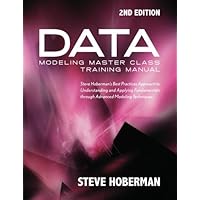
Data Modeling Master Class Training Manual 2nd Edition: Steve Hoberman's Best Practices Approach to Understanding and Applying Fundamentals Through Advanced Modeling Techniques Review

Data Modeling Master Class Training Manual 2nd Edition: Steve Hoberman's Best Practices Approach to Understanding and Applying Fundamentals Through Advanced Modeling Techniques
Average Reviews:

(More customer reviews)
This Master Class captures in one place much of the innovative stuff that Steve Hoberman has brought to the field of data modeling. It provides a great foundation to become a truly skilled data modeler. You can also follow Steve's continuing advances in the field as well as his design challenges at [...].

Click Here to see more reviews about: Data Modeling Master Class Training Manual 2nd Edition: Steve Hoberman's Best Practices Approach to Understanding and Applying Fundamentals Through Advanced Modeling Techniques

This is the second edition of the training manual for the Data Modeling Master Class that Steve Hoberman teaches onsite and through public classes. This text can be purchased prior to attending the Master Class, the latest course schedule and detailed description can be found on Steve Hoberman's website, stevehoberman.com.
The Master Class is a complete course on requirements gathering and data modeling, containing four days of practical techniques for producing solid relational and dimensional data models. After learning the styles and steps in gathering and modeling requirements, you will apply a best practices approach to building and validating data models through the Data Model ScorecardÂ. You will learn not just how to build a data model, but also how to build a data model well. Challenging exercises and workshops will reinforce the material and enable you to apply these techniques in your current projects.
By the end of the course, you will know how to…
Read a data model of any size and complexity
Validate any data model with the Data Model ScorecardÂ
Build relational and dimensional subject area, logical, and physical data models
Use abstraction
Gather requirements
Leverage a series of templates for capturing requirements
Write clear, complete, and correct definitions
Explain the critical factors that must be in place for a successful enterprise data model
Topics
Part 1: Modeling Basics. We will explain data modeling concepts and terminology. We will also explore each component on a data model and practice reading business rules.
Part 2: Overview to the Data Model ScorecardÂ. The Scorecard is a set of ten categories for validating a data model. We will explore best practices from the perspectives of both the modeler and reviewer, and you will be provided with a template to use on your current projects.
Part 3: Understanding subject area, logical, and physical data models. The subject area model captures a business need within a well-defined scope; the logical data model captures an application-independent business solution; and the physical data model captures the technical solution by focusing on factors such as performance and security. Each of these models will be explained in detail in this section.
Part 4: Ensuring the model captures the requirements. We will focus on techniques such as the use of spreadsheets and business assertions to ensure the data model meets the business requirements.
Part 5: Validating model scope. We will focus on techniques for validating that the scope of the requirements matches the scope of the model. If the scope of the model is greater than the requirements, we have a situation known as scope creep. If the model scope is less than the requirements, we will be leaving information out of the resulting application.
Part 6: Following acceptable modeling principles. We will focus on techniques for building sound designs.
Part 7: Determining the optimal use of generic concepts. We will focus on techniques for capturing the ideal use of generic concepts such as
Party and Event.
Part 8: Applying consistent naming standards. We will focus on techniques for applying correct and consistent naming standards.
Part 9: Arranging the model for maximum understanding. We will focus on techniques for arranging the entities, data elements, and relationships to maximize readability.
Part 10: Writing clear, correct, and consistent definitions. We will focus on techniques for writing useable definitions.
Part 11: Matching the model with the enterprise. We will focus on techniques for ensuring the model complements the big picture.
Part 12: Comparing the metadata with the data. We will focus on techniques for confirming the data elements and their rules match reality.


Buy Now

Click here for more information about Data Modeling Master Class Training Manual 2nd Edition: Steve Hoberman's Best Practices Approach to Understanding and Applying Fundamentals Through Advanced Modeling Techniques

Read More...

3/14/2012

A Pragmatic Guide to Business Process Modelling (2nd Ed) Review

A Pragmatic Guide to Business Process Modelling (2nd Ed)
Average Reviews:

(More customer reviews)
If you want to know what business really looks like and the requirements of business, then this book will be a very good choice for you. This book contains five chapters that analyses business tools and techniques. Among these five chapters, one of them named "teaching guide" helps me a lot with my paper in university. It tells much useful information about different types of teaching and how to develop professional training. I found this book in my university's library, but I recommend you to buy a paper book because I believe that will be more helpful.


Click Here to see more reviews about: A Pragmatic Guide to Business Process Modelling (2nd Ed)

Revised and expanded with 5 new chapters, the second edition of 'A Pragmatic Guide to Business Process Modelling' shows how effective and accurate modelling can deliver a more complete understanding of your business and its future requirements. Most organisations traditionally rely upon over-simplified activity diagrams that only map input and output, but by applying the visual modelling techniques described here, it is possible to measure and map your entire business, using the Unified Modelling Language (UML). Drawing upon his considerable experience in consulting, author Jon Holt covers all aspects of the BPM process, including analysis, specification, mapping, measurement and documentation. New chapters deal with the presentation of process information, enterprise architecture, business tools and a teaching guide.

Buy Now

Click here for more information about A Pragmatic Guide to Business Process Modelling (2nd Ed)

Read More...

3/12/2012

How Work Gets Done: Business Process Management, Basics and Beyond Review

How Work Gets Done: Business Process Management, Basics and Beyond
Average Reviews:

(More customer reviews)
First off, I have to admit I am not objective about this review. Artie Mahal is a good friend and we have worked together developing the methodology he describes in this book. That said, I'll be as objective as I can.
Artie began his process journey at Mars North America, when his boss asked him to take charge of a business process change project. He went on to become the head of BPM at Mars North America, to train process change agents throughout the corporation, and to help the company become a mature process-focused organization. When Artie retired from Mars North America he formed his own consulting company and also joined with BPTrends Associates. While at BPTrends Associates he has worked with Roger Burlton, me and others to develop the BPTrends Associates Methodology. We refer to the methodology as a "best practices" methodology because we did not set out to create a new methodology, but simply to structure the existing business practices that have developed over the past thirty years into a consistent, systematic framework that companies can use to solve process problems.
Artie's contribution to the development of the methodology has been significant, but much more significant, to my mind, has been his contribution to our training and consulting practice. Artie's extensive experience at Mars guarantees his ability to help organizations when they begin to develop their own process resources. He's been there and done it, and can tell you about the problems they had and how they overcome them. And, in the past few years, he's consulted with lots of other companies and learned about their problems and guided them through the beginnings of their own process journeys.
To my mind, however, Artie's greatest strength is as an instructor. Artie Mahal is one of the most knowledgeable and gifted instructors I have known. He brings an unbeatable combination of enthusiasm, empathy, knowledge, and energy to his classes. His students learn; but more important, they catch a spark and become enthusiastic about what they can do with the ideas Artie provides.
BPTrends Associates is currently working on a Methodology Handbook that will systematically document all of the steps and techniques we teach in the BPTrends Associates Methodology. Naturally, when I got Artie's book I looked to see whether he would be preempting our Handbook. Artie certainly does describe the BPTrends Associates approach, but he does so in his own friendly and enthusiastic way. This is not a methodological handbook - this is a book that is very like a conversation with Artie. He's sits you down, talks to you about the kinds of problems you will likely encounter and then suggests what kinds of approaches you should consider.
A quick glance at the contents will give you a feeling for the scope of the book:
1.Enterprise Business Model
2.Business Process Hierarchy
3.Business Process Blueprint
4.Anatomy of a Process
5.Process Knowledge
6.Business Models
7.Process Configuration
8.BPM Methodology
9.BPM Competencies
10.BPM Services
11.Software Tools
12.NewAge Foods Business Process Case Study
Everything is here - goals and strategies, alignment, scope diagrams, cause-effect diagrams, flow diagrams, process measures, redesign strategies and ideas about how to roll out a process. The focus is clearly on redesigning a broken process and the example walks readers through the steps of doing just that. But it does much more because it provides Artie's stories and his suggestions along the way.
When I first started writing books, I used to worry about who my audience was. (Publishers always ask you that.) After awhile I realized that my audience was myself: I write books to organize and explain things to myself. At the beginning of the book, Artie talks about being asked by his manager to take over a major process redesign project and looking for a guru to help him - and meeting Roger Burlton. Well, that was many years ago, and Artie has become a guru in his own right. I believe he has written this book to be the book he would have bought to help him when he was first given that assignment at the beginning of his career.
If you have ever wished you had a very practical friend who could sit down and talk you through just what's involved in improving how work gets done at your organization, this is the book!
I expect this is the book I will be recommending to those who are new to process work for the foreseeable future.


Click Here to see more reviews about: How Work Gets Done: Business Process Management, Basics and Beyond

Rediscover how your organization works and where it can be improved by using simple, yet powerful techniques!
How Work Gets Done will provide the business or IT professional with a practical working knowledge of Business Process Management (BPM). This book is written in a conversational style that encourages you to read it from start to finish and master these objectives:
Learn how to identify the goals and drivers important to your organization and how to align these with key performance measures
Understand how business strategies, business policies, and operational procedures need to be connected within a Business Process Architecture
Know the basic building blocks of any business process - Inputs, Outputs, Guides, and Enablers
Learn how to create a BPM Center of Excellence in your organization
Acquire the skills to establish a BPM methodology addressing Enterprise-level, Process-Level, and Implementation-Level priorities
Learn how to build a Process Competency Framework encompassing all BPM stakeholders
Obtain the knowledge to improve a process step-by-step with easy to use techniques and templates such as swimlanes and flowcharts

How Work Gets Done is a clear, concise, and well-navigated journey into the world of Business Processes and Business Process Management. From a practical introduction through advanced topics around methodology and competencies, it is suitable for business process newcomers and seasoned practitioners alike. It should be required reading at all levels of every organization. Eugene Fucetola - Global Application Messaging and Integration, Operations Manager, Mars Information Services

If you have always wished you had a very practical friend who could sit down and talk you through just what is involved improving how work gets done at your organization, this is the book!Paul Harmon - Executive Editor, Business Process Trends and Chief Methodologist, BPTrends Associates

Artie Mahal has done something that was thought to be impossible - produce an easily readable book about business process management. He paints pictures with words, offers many easy-to-grasp analogies, and stimulates with simplifying charts of complex concepts. Leon Fraser- Lecturer, Rutgers Business School

Chapter Listing:

Chapter 1 - Enterprise Business Model
Chapter 2 - Business Process Hierarchy
Chapter 3 - Business Process Blueprint
Chapter 4 - Anatomy of a Process
Chapter 5 - Process Knowledge
Chapter 6 - Business Models
Chapter 7 - Process Configuration
Chapter 8 - BPM Methodology
Chapter 9 - BPM Competencies
Chapter 10 - BPM Services
Chapter 11 - Software Tools
Chapter 12 - NewAge Foods Business Process Case Study


Buy NowGet 29% OFF

Click here for more information about How Work Gets Done: Business Process Management, Basics and Beyond

Read More...

11/15/2011

Modeling Dynamic Climate Systems (With CD-ROM) Review

Modeling Dynamic Climate Systems (With CD-ROM)
Average Reviews:

(More customer reviews)
This book aims to teach about climate modeling while presenting some fundamentals of atmospheric physics by providing numerous STELLA models ranging from a simple stability model of a leaky bucket to much more complex (and relevant) models for Rossby waves and El Nino. Though the models are not "rigorous", they are intended to show how simplifications can enhance understanding and how some simplifications meet the goals of the model while other times simplifications miss important aspects for accurate models.
For those who are looking for sophisticated programing and modeling approaches, they are sure to be disappointed. However, for those who are either trying to learn or teach basics of climate modeling to those with limited mathematical expertise or teaching students with such limited experience, this book will prove quite useful. The approximately 40 STELLA models included with the book guide the reader to an intuitive understanding of an Earth system approach of atmospheric science. I plan to use a number of examples with a group of students who have only a simple calculus background. Though the text has a 2001 copywrite and the CD-ROM was intended for an earlier version of STELLA, I found that the models could be translated to the newest versions of STELLA on a Macintosh through a fairly simple manipulations and help from software updates provided by High Performance Systems. The text would be useful for junior level classes in atmospheric science aimed at students in environmental science programs. It would be less useful for those with strong math skills majoring in a rigorous atmospheric science sequence, though it could provide such students with a much better conceptual understanding than they might receive in a more mathematically sophisticated class.

Click Here to see more reviews about: Modeling Dynamic Climate Systems (With CD-ROM)

In the process of building and using models to comprehend the dynamics of the atmosphere, ocean and climate, the reader will learn how the different components of climate systems function, interact with each other, and vary over time. Topics include the stability of climate, Earths energy balance, parcel dynamics in the atmosphere, the mechanisms of heat transport in the climate system, and mechanisms of climate variability. Special attention is given to the effects of climate change. The book is accompanied by a cross-platform CD-ROM containing models and a run-time version of STELLA modeling software.

Buy NowGet 20% OFF

Click here for more information about Modeling Dynamic Climate Systems (With CD-ROM)

Read More...

11/05/2011

Modeling for Learning Organizations (System Dynamics Series) Review

Modeling for Learning Organizations (System Dynamics Series)
Average Reviews:

(More customer reviews)
"Modeling for Learning Organizations" builds off of the extensive experience of top professors and consultants using the SD tools to test strategies and build an understanding of firm and industry dynamics.
"Modeling" also includes a section overviewing the various simulation software packages available to modelers. Though developers like High-Performance Systems, Vensim, Pugh-Roberts, and PowerSim have made product enhancements to date, the sections from each company provide a great introduction to what is out there how each package can be applied.
The most valuable aspect of the book is probably in the case studies and methodological explorations of several authors. A number of key insights are offered as authors reflect upon the successes and shortcoming of the methods each chose to use to explore and develop models in a variety of business and public environments.
This is definitely a must have for any SD library.

Click Here to see more reviews about: Modeling for Learning Organizations (System Dynamics Series)

Conventional wisdom says that we can learn from our errors, but errors in the business world can be prohibitively costly. To truly understand how complex business organizations function requires different tools than most managers have been given. Yet managers need methods to understand how their organization works in order to test policies, discover flaws in thinking, and find the hidden leveragepoints within the complex systems they manage. Through a system simulation, the dynamics of the whole system, not just the individual parts, becomes apparent. The outcome of current and future situations becomes possible to predict and with this information, managers can focus on the changes that need to be made.The distinguished contributors to Modeling for Learning Organizations include Jay W. Forrester, Peter Senge, and Arie De Geus. You will learn about leading applications such as:
Shell's work on modeling the oil producers.
The Management Flight Simulator, a computer-based case learning environment pioneered by John Sterman and others at MIT
The landmark Claims Learning Laboratory at Hanover Insurancecompanies.
For managers, professionals, academicians, and everyone who recognizes the profound implications of modeling, this book is an excellent resource. It offers a broad understanding of the modeling process, discusses a multitude of case studies, and provides a review of the most recent simulation software.

Buy Now

Click here for more information about Modeling for Learning Organizations (System Dynamics Series)

Read More...

10/21/2011

Systems Science and Modeling for Ecological Economics Review

Systems Science and Modeling for Ecological Economics
Average Reviews:

(More customer reviews)
If you did not do modeling before and have no idea where to start from - this book is for you. It is well written and it is fun!
I had to do some modeling for a project that I have been working on. At that moment I did not have much experience in modeling, especially in modeling coupled economic and natural systems. I was looking for a good guide in ecological economic modeling but could not find anything user-friendly and interdisciplinary. I came across the web-course by Dr. Voinov and started it. The book is a great addition to the course. The web-course as well as this textbook lead you through the essential steps of model design and implementation, introduce you to main challenges and ways to resolve them, and give you some great illustrations from practical applications of ecological economics. I especially like that it provides not only the theory of modeling for ecological economics but also discusses software tools and gives you hands on experience with the exercises. I was very excited to see that the textbook is out there now. Enjoy!


Click Here to see more reviews about: Systems Science and Modeling for Ecological Economics

Modeling is a key component to sciences from mathematics to life science, including environmental and ecological studies. By looking at the underlying concepts of the software, we can make sure that we build mathematically feasible models and that we get the most out of the data and information that we have. This book shows how models can be analyzed using simple math and software to generate meaningful qualitative descriptions of system dynamics. This book shows that even without a full analytical, mathematically rigorous analysis of the equations, there may be ways to derive some qualitative understanding of general behavior of a system. By relating some of the modeling approaches and systems theory to real world examples the book illustrates how these approaches can help understand concepts such as sustainability, peak oil, adaptive management, optimal harvest and other practical applications. * Relates modeling approaches and systems theory to real world examples * Teaches students to build mathematically feasible models and get the most of our the data and information available* Wide range of applications in hydrology, population dynamics, market cycles, sustainability theory, management, and more

Buy Now

Click here for more information about Systems Science and Modeling for Ecological Economics

Read More...

9/01/2011

Modeling the Environment, Second Edition Review

Modeling the Environment, Second Edition
Average Reviews:

(More customer reviews)
A highly readable introduction to environmental modeling. What distinguishes the book from other environmental science and environmental modeling works is its interdisciplinary treatment. In particular, the models integrate the physical world and the world of human behavior. Far too many environmental models fail to close the feedbacks between human behavior and the state of the environment, instead taking waste inputs or resource use as exogenous. This book helps students learn to model human behavior (social and economic) as an integral part of the ecological system. The models and software mean the book encourages active learning, and enable students to explore important issues on their own if they choose.

Click Here to see more reviews about: Modeling the Environment, Second Edition

Modeling the Environment was the first textbook in an emerging field-the modeling techniques that allow managers and researchers to see in advance the consequences of actions and policies in environmental management. This new edition brings the book thoroughly up to date and reaffirms its status as the leading introductory text on the subject. System dynamics is one of the most widely known and widely used methods of modeling. The fundamental principles of this approach are demonstrated here with a wide range of examples, including geo-hydrology, population biology, epidemiology and economics. The applications demonstrate the transferability of the systems approach across disciplines, across spatial scales, and across time scales. All of the models are implemented with stock and flow software programs such as Stella and Vensim. These programs are easy and fun to learn, and they allow students to develop realistic models within the first few weeks of a college course. System dynamics has emerged as the most common approach in collaborative projects to address environmental problems. The stock and flow structures and the emphasis on feedback control provide a common language that is understood by scientists from many disciplines. Although the interdisciplinary approach described here is widely used in practice, there are few books to aid instruction. Modeling the Environment meets the urgent need for instructional materials in interdisciplinary modeling of environmental systems.


Buy NowGet 10% OFF

Click here for more information about Modeling the Environment, Second Edition

Read More...