Showing posts with label multimedia. Show all posts

5/21/2012

Designing Virtual Reality Systems: The Structured Approach Review

Designing Virtual Reality Systems: The Structured Approach
Average Reviews:

(More customer reviews)
This text does not pertain to any new research in the field of virtual reality or virtual environments. Instead, it is meant to be a modern introduction (post VRML) to students new to VR on what building blocks are required to produce a virtual reality system. I review the book in the context of its table of contents:
Chapter 1 "Introduction: Virtual Reality in a Nutshell" is just a broad overview of the field and of this book. It discusses the goals and applications of VR, and also discusses what it considers to be the two pillars of VR: presence and 3D multimodal interaction.
Chapter 2 "Requirements Engineering and Storyboarding" discusses VR from the standpoint of a concrete example: a ship simulator design.
Chapter 3 "Object and Scene Modeling" discusses object modeling, scene construction, object placement, multiple frames of reference, re-expressing coordinate systems, and both functional and behavioral modeling. All of this is done from the standpoint of the ship simulator design that was introduced in chapter two. There is quite a bit about graphics concepts in this chapter.
Chapter 4 "Putting it All Together" pulls together the concepts from chapters 2 and 3 into a system design philosophy, again from the standpoint of the concrete example of the ship simulator design.
Chapter 5 "Performance Estimation and System Tuning" is somewhat mislabeled in my opinion. This chapter discusses some advanced graphics concepts such as tuning with level-of-detail models, presence and special effects, and use of images and texturing.
Chapter 6 "Output Display" is about human optical perception as well as available display hardware. First the human visual system is briefly discussed along with human depth perception and stereoscopy. Next visual display systems are discussed along with haptics - the science of applying touch sensation and control to interaction with computer applications.
Chapter 7 "Sensors and Input Processing" discusses trackers, event generators, and sensor errors and calibration.
Chapter 8 "3D Multimodal Interaction Design" is about fusing symbolic and statistical information from a set of 3D gesture, spoken language, and referential agents. In particular, a structured approach is presented, along with ideas on interfacing, and finally some case studies. Among the case studies are the previously mentioned ship simulator along with immersive authoring, tabletop computing, menu selection and invocation, and whole-body interaction.
Next, there are two short chapters on simulation.
Chapter 9 discusses the basics of collision detection, starting with collision detection of line segments, then moving on to collision among polygonal models, building a bounding volume, and finally collision among bounding volumes.
Chapter 10 introduces physics based motion and collision response. Among the topics mentioned are center of gravity, moment of inertia, linear and rotational kinematics, laws of motion, dynamics, collision response, and deformation. There are quite a few equations shown in this chapter, and although this is just meant as an introduction the material is quite useful.
Chapter 11 "Virtual Characters" is the final chapter and touches on a rather advanced subject. The form of such a character, motion control, and inverse and forward kinematics of such a character are discussed.
Although this is a short book - roughly 230 pages total - it is very useful in that it does not wander through its topics in an academic way, but takes a systems engineering and mathematical approach to building virtual worlds. The use of the ship simulator is very enlightening and binds the book together into a very cohesive and useful volume. The block diagrams and pseudocode are also very helpful. You are going to need other books to build a complete virtual world, but this is an outstanding modern outline of everything that you need to consider. I highly recommend this book as an introductory text to any student wishing to learn the practical issues behind building a virtual reality system.

Click Here to see more reviews about: Designing Virtual Reality Systems: The Structured Approach

Developing and maintaining a VR system is a very difficult task, requiring in-depth knowledge in many disciplines. The difficulty lies in the complexity of having to simultaneously consider many system goals, some of which are conflicting.This book is organized so that it follows a spiral development process for each stage, describing the problem and possible solutions for each stage. Much more hands-on than other introductory books, concrete examples and practical solutions to the technical challenges in building a VR system are provided.Part 1 covers the very basics in building a VR systemand explains various technical issues in object modeling and scene organization. Part 2 deals with 3D multimodal interaction, designing for usable and natural interaction and creating realistic object simulation. Primarily written for first level graduates, advanced undergraduates and IT professionals will also find this a valuable guide.

Buy NowGet 20% OFF

Click here for more information about Designing Virtual Reality Systems: The Structured Approach

Read More...

1/07/2012

Continuum Mechanics using Mathematica®: Fundamentals, Applications and Scientific Computing (Modeling and Simulation in Science, Engineering and Technology) Review

Continuum Mechanics using Mathematica®: Fundamentals, Applications and Scientific Computing (Modeling and Simulation in Science, Engineering and Technology)
Average Reviews:

(More customer reviews)
The mathematics discussed here is quite involved. Including tensor analysis, stress-strain relations and the non-linear Navier Stokes equation. Much of the work involves numerical analysis, as there are no analytic solutions to many problems.
You can treat the book as a standard, advanced text on the subject. But the added filip here is how it shows Mathematica can be used. Most general purpose texts on Mathematica involve simpler maths; high school or undergraduate level. Yet the program is quite powerful.
The book seems aimed at those scientists and engineers who are not primarily programmers. The idea is to let Mathematica offload much of the programming burden. The tradeoff might be that a loss of efficiency vis a vis custom code. But that might be acceptable to you.

Click Here to see more reviews about: Continuum Mechanics using Mathematica®: Fundamentals, Applications and Scientific Computing (Modeling and Simulation in Science, Engineering and Technology)

This book's methodological approach familiarizes readers with themathematical tools required to correctly define and solve problems incontinuum mechanics. The book covers essential principles andfundamental applications, and provides a solid basis for a deeperstudy of more challenging and specialized problems related toelasticity, fluid mechanics, plasticity, materials with memory,piezoelectricity, ferroelectricity, magneto-fluid mechanics, and state changes.Key topics and features: * Concise presentation strikes a balance between fundamentals andapplications* Requisite mathematical background carefully collected in two introductory chapters and two appendices* CD-ROM containing Mathematica-based exercises, examples, andprograms related to the text; this user-friendly software is unique inthe literature and allows readers to quickly solve complex,time-consuming problems related to the application areas covered* Recent developments highlighted through coverage of more significant applications to areas such as porous media, electromagnetic fields,and phase transitionsContinuum Mechanics using Mathematica is aimed at advancedundergraduates, graduate students, and researchers in appliedmathematics, mathematical physics, and engineering. It may serve as acourse textbook or self-study reference for anyone seeking a solidfoundation in the field.

Buy NowGet 20% OFF

Click here for more information about Continuum Mechanics using Mathematica®: Fundamentals, Applications and Scientific Computing (Modeling and Simulation in Science, Engineering and Technology)

Read More...

9/11/2011

Learning Autodesk Maya 2008, (Official Autodesk Training Guide, includes DVD): The Modeling & Animation Handbook Review

Learning Autodesk Maya 2008, (Official Autodesk Training Guide, includes DVD): The Modeling and Animation Handbook
Average Reviews:

(More customer reviews)
Official Autodesk Training Guides are a superb investment and this book in particular, is terrific. If you have an intermediate-level of knowledge about Maya, you will find this book moves at a fairly quick pace. Also, if you have a good working knowledge of the Maya interface and its tools, but lack the discipline of a solid production workflow then book will enhance your skills and round out your education.
I am a beginner with only peripheral knowledge of the Maya interface but because the book is so well written I have been able to keep pace and have learned more in the last few weeks than I have gained in the hundreds of hours of parroting the video tutorials available online.
I've spent a small fortune in the last few months buying Maya video tutorials from a couple of different online sources and for the most part, they provide you with all the steps necessary to create the models you see in the videos and expose you to many aspects of the software, but what these videos don't do is explain the "why", which is necessary if you are to grow and take your creativity to the next level.
In all fairness to the authors of these videos, they are working with self-imposed limitations and the knowledge to be gleaned from the videos is only as good as the individual who wrote the lesson guide. Therefore, I decided before I get too far along in my Maya learning experience, I needed a good working knowledge of the fundamentals and who better to provide that than the "official" experts.
Breakout the videos if you want to build a good looking Mitsubishi car in twenty-hours time but buy this book if you plan to "design" the next Mitsubishi car. Therein lies the difference between their videos and this Autodesk series of books; not only do these books explain the "why", they provide the discipline necessary for a dependable production workflow, which is critical if you intend to work in this field.
By the time you finish this book you will know the key concepts and workflows of Maya. You will know the tools and their application. You will learn modeling and animation and understand how they relate to each other in a production pipeline.

Click Here to see more reviews about: Learning Autodesk Maya 2008, (Official Autodesk Training Guide, includes DVD): The Modeling & Animation Handbook


Buy NowGet 37% OFF

Click here for more information about Learning Autodesk Maya 2008, (Official Autodesk Training Guide, includes DVD): The Modeling & Animation Handbook

Read More...

8/23/2011

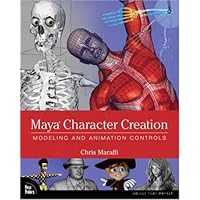
Maya Character Creation: Modeling and Animation Controls Review

Maya Character Creation: Modeling and Animation Controls
Average Reviews:

(More customer reviews)
First impressions. A quick glance through the book reveals that this book is for beginning to intermediate Maya users. It includes all one needs to know about character modeling and preparing the model for animation from modeling to skeleton setup to skinning to scripting. Actual character animation itself is not covered in this book.
The book is illustrated with many sketches and screenshots but the illustrations are not in color which makes some of the screenshots hard to see especially the ones with wireframe models.
As the book concentrates on character setup, the examples and tutorials in the book involve creating and working with fairly realistic characters that have muscle and bone structure. If you are only interested in creating highly stylized or simple characters for use in your animation then you won't find much that is useful in this book. If you want to create the next Gollum then read on.
The book starts off with some information on the evolution of digital characters in film. This is followed by an introduction on the basics of character modeling.
The next chapter is on modeling the skin of a biped character and this happens to be the biggest chapter in this book. It begins with an introduction on different modeling methods for modeling a head, usually the most difficult part to model. Here and in the rest of the book as well, the author explains carefully on the pros and cons of each method and possible associated pitfalls that might be encountered when the model is used in an animation later on. Most books on modeling do not take into consideration the problems that might arise later on when animating the model and character animation books usually concentrate on the animation aspects. The author of this book does a commendable job of getting both these bases covered.
This is followed by modeling of the torso and limbs. Later on, the multipatch character is converted into a polygon skin to simplify the process of adding details to the model. Last but not least this chapter covers skin texturing including the use of UV polygons.
There are exercises intersped within the chapters after every few section which covers in detail with step by step instructions on how to perform the lessons covered in the previous sections. Although the steps are explained carefully it would have been better if more accompanying screenshots had been included to guide the reader. As it is, great care has to be taken to read the text carefully as there is no graphical reference to compare if the steps have been followed correctly.
Chapter 3 is on character skeleton setup. This brings back memories of my biology classes as the author covers the importance of having a good understanding of the skeletal anatomy of the human body. Both Forward Kinematics (FK) and Inverse Kinematics (IK) are explained as is when each method is to be used. Pointers to naming convention is included.
All of the above is then employed to create a basic character rig. Controls are added to the rig using the Connection Editor, the Expression Editor or the set driven keys to simplify animation with samples and exercises for each method. Each method is covered in detail in this chapter.
Chapter 4 covers skin deformation with a process known as skin binding with focus on the smooth skin binding method. Muscle flexing using both muscle skeleton and influence objects are covered. For additional realism, methods on deforming the skin with bones, wrinkles and fat are given attention as well.
Face animation is up next. Because it's the most expressive part of the body, special attention has to be given to the animation controls in this area. Techniques such as morph targets and using influences to mimic facial muscles are included as well.
The next chapter is on scripting controls using Maya Embedded Language, something that most Maya users including myself, find daunting. Only the basics are covered with a little information on what advanced scripting can do. Although this chapter only scratches the surface on MEL, it serves it's purpose of whetting the reader's appetite for more information.
The book ends with some guidelines on finishing touches like cleaning up and optimizing the character controls. Some animation methods are also covered and lastly, readers learn how to simplify and streamline animation by using multiple rigs of varying complexity.
Overall, the book is informative and would be a valuable asset to it's targeted audience, beginning to intermediate level Maya users who want to learn about character modeling and setting up the models for animation. The exercises are detailed enough but illustrations and the use of colors are a bit lacking.
The author's style of writing is easy to comprehend and I liked the way how each chapter is nicely summarized at the beginning of each chapter with an indication of what the reader can hope to accomplish at the conclusion of the chapter.

Click Here to see more reviews about: Maya Character Creation: Modeling and Animation Controls

A unique, in-depth approach to creating realistic characters in Maya. Maya Character Creation: Modeling and Animation Controls' author, Chris Maraffi, has expertise in the field and in the classroom that translates to the knowledge and solid teaching skills needed to make this book a "must-have"!The current trend in computer graphics is greater organic realism. Many of thetop-grossing movies today, such as Spiderman, Lord of the Rings, Jurassic Park 3 ,and Star Wars Episode 2, all feature realistic 3D characters. There is a majorneed in the 3D community for educational material that demonstrates detailedtechniques for achieving this organic reality. Maya is one of the main packagesused on such cutting-edge films, and has an established toolset for creatingbelievable 3D characters. Maya Character Creation: Modeling and Animation Controls is designed to take you through the process of designing, modeling, and setting up animation controls for complex 3D characters. The concepts, techniques, and Maya tools used foreach step in the process are presented in each chapter, followed by manyhands-on exercises. NURBS, polygon, and subdivision surface modelingtechniques are shown for creating the character's skin, and skeleton-basedanimation controls are covered in detail. You will learn how a character'sskin should deform when the skeletal joints and muscles move. AdvancedMEL scripted animation controls are also covered extensively.

Buy NowGet 32% OFF

Click here for more information about Maya Character Creation: Modeling and Animation Controls

Read More...