Showing posts with label algorithm design. Show all posts

7/25/2012

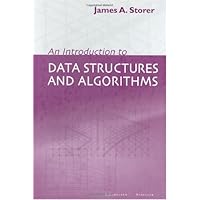
An Introduction to Data Structures and Algorithms (Progress in Theoretical Computer Science) Review

An Introduction to Data Structures and Algorithms (Progress in Theoretical Computer Science)
Average Reviews:

(More customer reviews)
If you have cut your teeth on Donald Knuth's classic three volumes, "The Art of Computer Programming", and you want more detail, at a similar level of complexity, then consider Storer's book.
It delves into lists, recursion, trees, graphs, heaps and sets. Like Knuth, Storer thoughtfully supplies an extensive list of questions at the end of each chapter that will greatly deepen your appreciation of the field if you tackle them. Ok, he doesn't give answers, but think of that as greater incentive on your part to solve them. There are almost 400 questions in the book.
The teaching style is similar to Knuth, in that it has all the rigour needed by an algorithm designer like yourself, without drowning you in epsilon-delta ultra rigour like a pure maths text.
Note that the only code fragments are in pseudocode. This should not be a problem for you. I am assuming you are experienced enough that what you need is understanding of an algorithm, and that manually converting it to code is straightforward and a purely secondary issue.
The take home message is that this is excellent for anyone doing serious programming.

Click Here to see more reviews about: An Introduction to Data Structures and Algorithms (Progress in Theoretical Computer Science)

Data structures and algorithms are presented at the college level in a highly accessible format that presents material with one-page displays in a way that will appeal to both teachers and students. The thirteen chapters cover: Models of Computation, Lists, Induction and Recursion, Trees, Algorithm Design, Hashing, Heaps, Balanced Trees, Sets Over a Small Universe, Graphs, Strings, Discrete Fourier Transform, Parallel Computation. Key features: Complicated concepts are expressed clearly in a single page with minimal notation and without the "clutter" of the syntax of a particular programming language; algorithms are presented with self-explanatory "pseudo-code." * Chapters 1-4 focus on elementary concepts, the exposition unfolding at a slower pace. Sample exercises with solutions are provided. Sections that may be skipped for an introductory course are starred. Requires only some basic mathematics background and some computer programming experience. * Chapters 5-13 progress at a faster pace. The material is suitable for undergraduates or first-year graduates who need only review Chapters 1 -4. * This book may be used for a one-semester introductory course (based on Chapters 1-4 and portions of the chapters on algorithm design, hashing, and graph algorithms) and for a one-semester advanced course that starts at Chapter 5. A year-long course may be based on the entire book. * Sorting, often perceived as rather technical, is not treated as a separate chapter, but is used in many examples (including bubble sort, merge sort, tree sort, heap sort, quick sort, and several parallel algorithms). Also, lower bounds on sorting by comparisons are included with the presentation of heaps in the context of lower bounds for comparison-based structures. * Chapter 13 on parallel models of computation is something of a mini-book itself, and a good way to end a course. Although it is not clear what parallel

Buy NowGet 48% OFF

Click here for more information about An Introduction to Data Structures and Algorithms (Progress in Theoretical Computer Science)

Read More...

7/10/2012

Designing Concurrent, Distributed, and Real-Time Applications with UML Review

Designing Concurrent, Distributed, and Real-Time Applications with UML
Average Reviews:

(More customer reviews)
This book provides a practical method to apply the Unified Modeling Language (UML) to design concurrent and distributed software for large systems. While many books have been published to explain the details of the UML notation, this book provides a method, COMET, to approach software design through application of a practical subset of the UML notation. The book contains numerous, extensive case studies and provides pragmatic, useful guidelines to identify distributed subsystems and concurrent tasks from a UML analysis model. The approach described represents a unique and valualbe contribution by the author of this text. Finally, because this book is intended mainly as a text for software design courses, I consulted with a few students who have used this book in a graduate-level software engineering course. All of the students were favorably impressed with the content, clarity, practicality, and detail contained in the book.
Prior to the publication of this text, a software design course based on UML could only be taught using a UML text together with a separate software design text. In this text book, Dr. Gomaa has integrated material from UML and software design in such a form that a software design course can now be taught with this text alone.

Click Here to see more reviews about: Designing Concurrent, Distributed, and Real-Time Applications with UML

In this book, renowned real-time software expert Hassan Gomaa adapts UML to the unique needs of the concurrent, distributed, and real-time applications -- helping developers leverage the powerful flexibility, reliability, and time-to-market benefits associated with UML. Gomaa starts by reviewing the key issues and concepts associated with analysis and design of distributed and real-time applications -- focusing not only on standard object-oriented concepts such as information hiding, classes, and inheritance, but also specialized issues such as finite state machines, concurrent tasks, and real-time scheduling. Next, he introduces the COMET (Concurrent Object Modeling and Architectural Design) Method, a UML-based object-oriented analysis and design method specifically created for concurrent, distributed, and real-time applications. The book presents detailed structuring criteria that assist the designer at every stage of the analysis and design process, and offers exceptional insight into dynamic modeling, concurrency, distributed application design, and performance analysis of real-time designs.Gomaa concludes with several detailed case studies covering a broad range of applications, including systems for banking, e-Commerce, cruise control, factory automation, and more.

Buy NowGet 20% OFF

Click here for more information about Designing Concurrent, Distributed, and Real-Time Applications with UML

Read More...